
12:40 AM, a kitchen in Delray, post-party. A woman we'll call Ingrid — the spec-sheet engineer; of course she's back — is drinking water and being interrogated by her husband, who has just proposed a plan. "What if I just... do jumping jacks? Sweat it out? Speed up the processing?" Ingrid, an engineer to her bones, sets down the glass: "There is one machine doing this job. It runs at one speed. You cannot help it, motivate it, or add a second shift. Would you like the schematic?" He would not. You might.
The two-step pathway
Ethanol's route through you is short, specific, and entirely in the liver. Step one: the enzyme alcohol dehydrogenase (ADH) converts ethanol into acetaldehyde — and this is the compound that matters: genuinely toxic, inflammatory, roughly ten to thirty times nastier than the drink that made it, and the primary villain in hangover science. Step two: aldehyde dehydrogenase (ALDH) converts acetaldehyde into acetate — harmless, eventually exiting as CO₂ and water. Two enzymes, one hallway. And the operationally decisive fact: both work at a near-fixed rate, saturated at low concentrations — roughly one standard drink per hour for most adults, unmovable by will, jumping jacks, or coffee.
Drinking faster doesn't speed the liver. It queues alcohol in your bloodstream — which is the actual definition of getting drunk.
What the fixed rate means at the bar
Every practical drinking rule in this catalog falls out of that one constraint. Pacing is the only real-time lever — one per hour tracks the machine; anything faster is deposit-in-the-bloodstream. Food slows delivery to the fixed pipeline (it can't speed processing, but it can smooth arrivals — hence the flattened curve). Nothing accelerates clearance — not coffee, cold showers, exercise, or the entire folk pharmacy; those manipulate how awake you feel while acetaldehyde works its shift regardless. And the enzymes vary genetically, which is why some people flush, some tolerate, and everyone knows one person who defies the group's arithmetic.
The NAD⁺ bill
Here's the part that connects the hangover to the rest of this site: both steps consume NAD⁺ as a cofactor. Alcohol metabolism is one of the body's most NAD⁺-expensive routine processes — a heavy night effectively diverts a large share of a cellular currency that everything else runs on: energy production, DNA repair, the works. That's the cellular answer to "why am I flat for two days, not just hungover" — and why the NAD-and-alcohol article exists as its own boundary-respecting conversation. The morning-after formula follows the biochemistry exactly: fluids for the diuresis, electrolytes for the export, B vitamins for the spend, and symptom control for the acetaldehyde's inflammatory wake.
Support the aftermath
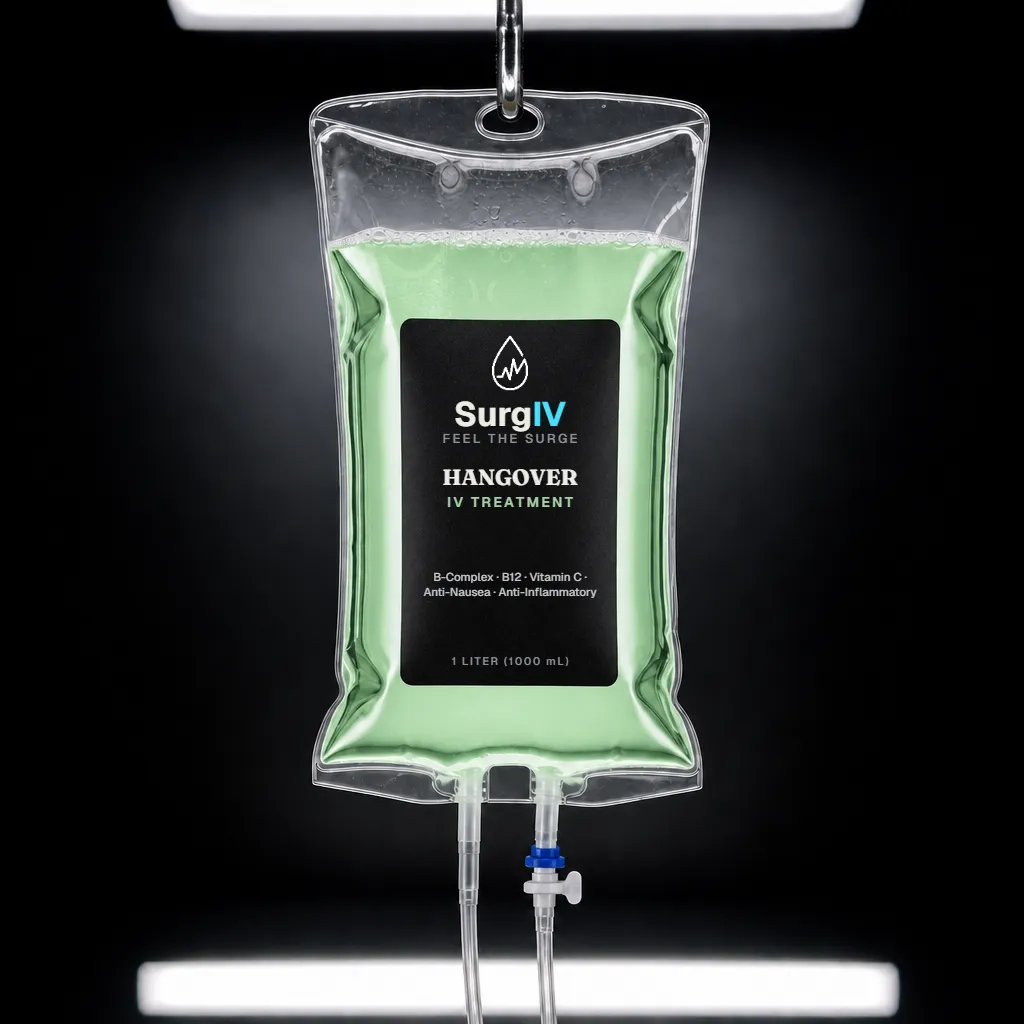
Hangover $249
The pathway spends fluids, B vitamins, and NAD⁺. Restock all three.
B-Complex · B12 · Vitamin C · Anti-Nausea · Anti-Inflammatory
Ingrid's husband, schematic received
He skipped the jumping jacks, drank the water, ate the eggs, and slept — the only three moves the schematic endorses. His revised position, delivered the next morning with the enthusiasm of a man who has met a rate limit: "One machine. One speed. No second shift. I hate it and I respect it." That's the whole biochemistry. Everything else in the hangover aisle is theater around a fixed hourly rate.
This article is for general education and is not medical advice. IV therapy at SurgIV is administered by registered nurses under physician-written protocols, with a health screening before your first visit. Talk to your doctor about what is right for you.