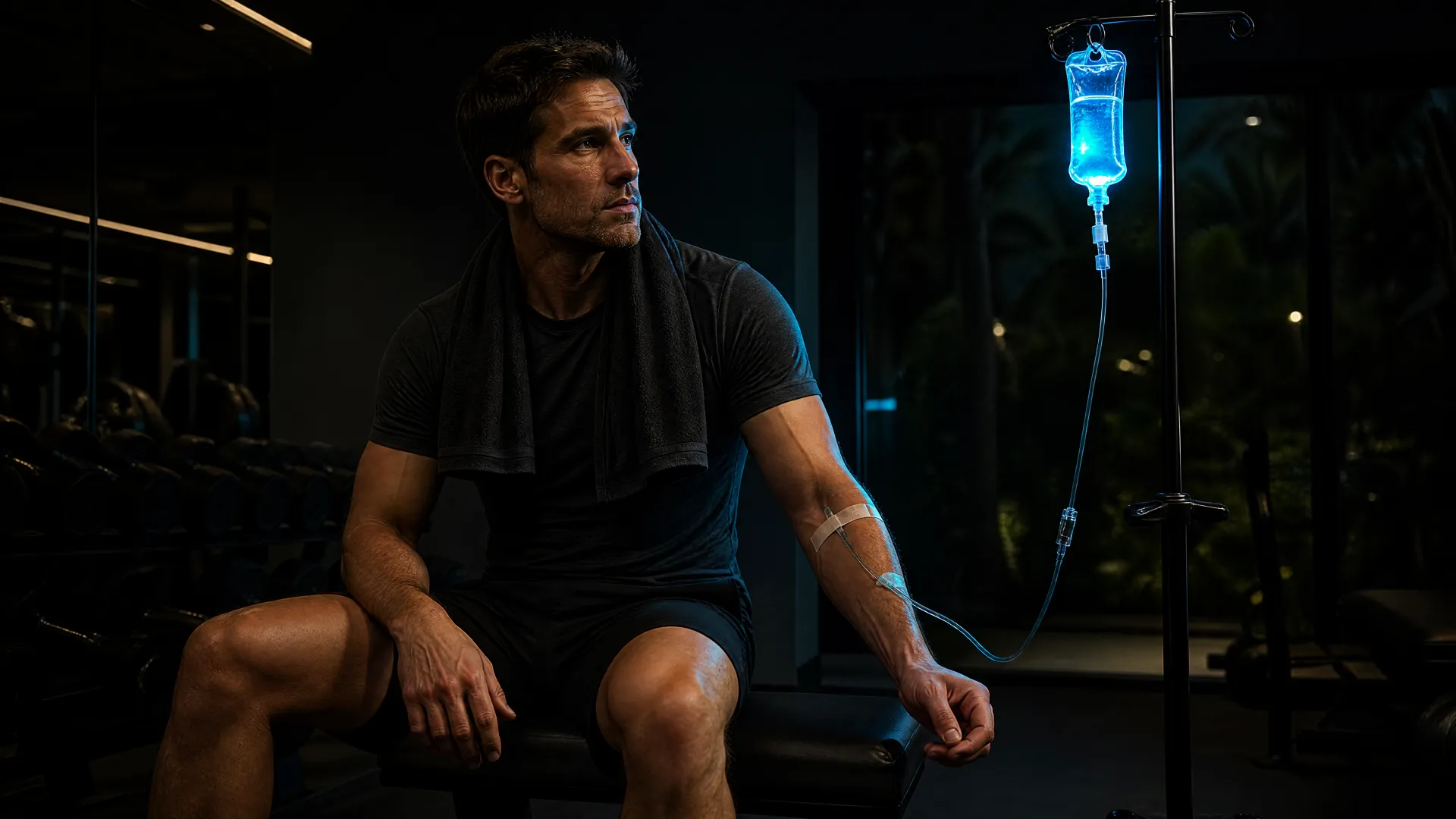
There's a specific kind of tired that doesn't show up in your twenties. It's not soreness — you know soreness. It's the Tuesday after a hard Saturday, when your legs are technically fine but everything runs at 85%. It's needing a rest day where you used to need a coffee. It's looking at the workout you love and negotiating with it.
Most athletes over 35 read this as a verdict: this is aging, lower the volume. And so begins the slow retreat — fewer sessions, shorter rounds, softer goals. But in most cases the training was never the problem. The recovery was.
Recovery is a resource problem, not a rest problem
Recovery isn't passive. Rebuilding muscle fiber, clearing metabolic waste, restoring glycogen, calming inflammation — every one of those jobs is active cellular work, and active work runs on resources: water, electrolytes, amino acids, B vitamins, antioxidants, and above all, cellular energy itself.
Here's what changed since your twenties: the demand didn't go up. The supply went down. The molecule at the center of cellular energy production — NAD⁺ (nicotinamide adenine dinucleotide) — declines steadily with age; research suggests levels may fall to roughly half by middle age. NAD⁺ is the coenzyme your mitochondria use to turn food into usable energy. Less of it means every repair job your body runs overnight gets done slower, on a tighter budget.
You didn't lose your fitness. Your cells lost their operating budget.
That's why "just sleep more" only half-works. Sleep is when the repair happens — but sleep doesn't supply the raw materials. Eight hours in bed with depleted cellular resources is a night shift with no inventory in the warehouse.
Why the usual fixes fall flat
- More caffeine masks fatigue signals; it doesn't fund recovery. You're borrowing tomorrow's energy at interest.
- Protein alone supplies building blocks but not the energy to assemble them — necessary, not sufficient.
- Oral supplements run into the absorption wall: swallowed nutrients pass through digestion, where uptake of many key compounds drops sharply with dose. A capsule's label and what reaches your bloodstream are two different numbers.
- Deload weeks reduce demand instead of raising supply — they manage the decline rather than reversing it.
What refueling actually looks like
This is the logic behind The Surge, our flagship IV. It's built as a complete recovery stack delivered intravenously — meaning 100% of it reaches your bloodstream, none of it lost to digestion:
- A full liter of IV fluids and electrolytes — the baseline everything else depends on. Most hard-training adults in the Florida heat live mildly dehydrated without knowing it.
- Amino acids (L-carnitine, taurine) — involved in muscle energy metabolism and repair.
- B-complex and B12 — the vitamin family your energy-production pathways spend constantly.
- Glutathione (1000mg) — the body's master antioxidant, supporting cleanup of the oxidative stress hard training produces.
- NAD⁺ (500mg) — the centerpiece. The coenzyme your mitochondria run on, restored directly rather than hoped for.
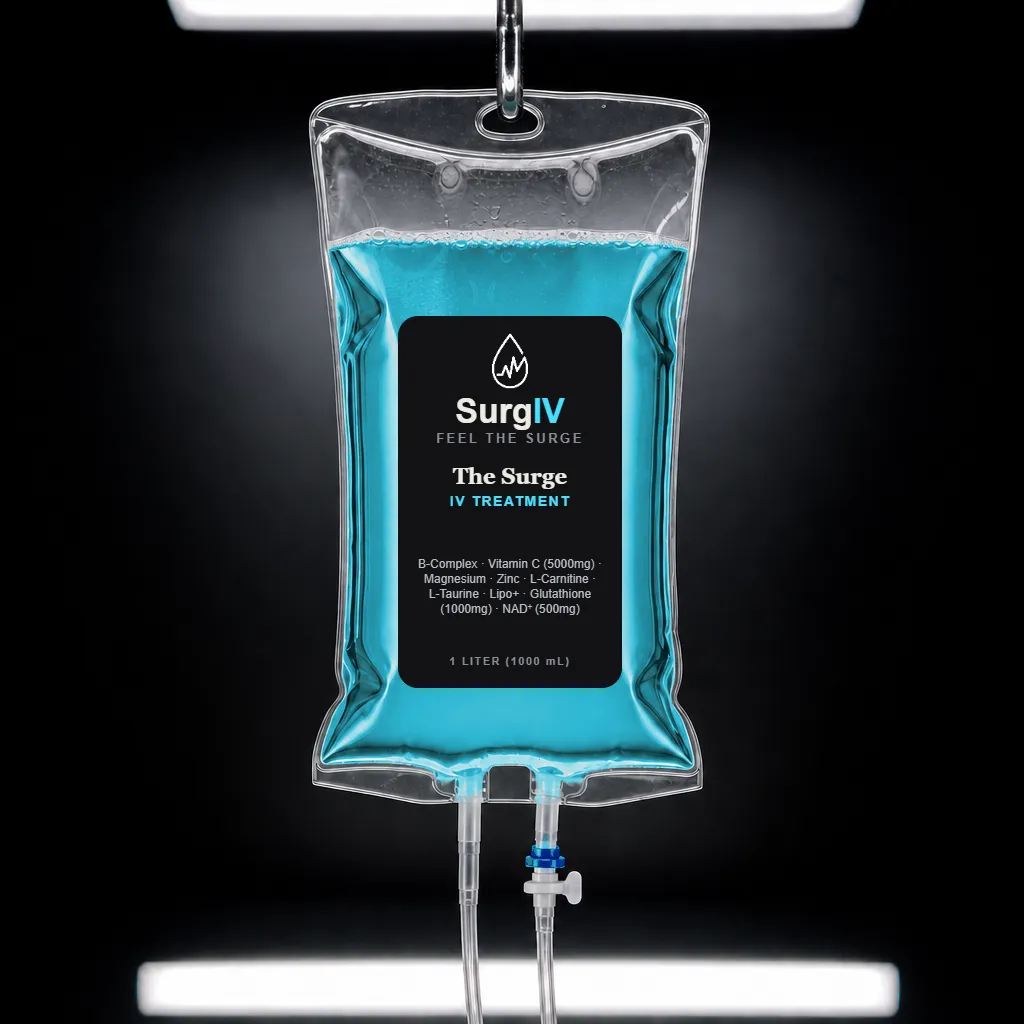
The complete recovery formula, delivered to your door.
The Surge $899
Hydration, aminos, B-complex, glutathione and 500mg NAD⁺ — administered by a registered nurse, anywhere in Palm Beach County.
IV Bag: B-Complex · Vitamin C (5000mg) · Zinc · Magnesium · L-Carnitine · L-Taurine · Lipo+ + more
What our members actually report
We're careful with promises — everyone's physiology is different, and IV therapy supports recovery rather than replacing training fundamentals. But the pattern our members describe is remarkably consistent: the two-day recovery tax shrinks. The Tuesday legs come back online Monday. The negotiation with the workout stops, because the workout stopped costing so much.
One of our members, 62, put it best: "I'm training harder than I have in years." Not because the training got easier — because the recovering did.
The honest math
A session of The Surge runs 60–90 minutes, at your home, gym, or office, administered by a registered nurse under physician-written protocols. You don't drive anywhere, you don't sit in a clinic — the drip comes to you, anywhere in Palm Beach County, often same-day.
If you're spending hundreds a month on training you're too depleted to benefit from, the question isn't whether recovery is worth investing in. It's how much of your training investment you're currently losing to the recovery gap.
This article is for general education and is not medical advice. IV therapy at SurgIV is administered by registered nurses under physician-written protocols, with a health screening before your first visit. Talk to your doctor about what is right for you.