Every family has a naming disaster, and the B vitamins are nutrition's: eight essential compounds numbered 1 through 12 with gaps where the fired members used to be (B4, B8, B10 and B11 got reclassified decades ago — long story, chemistry politics). The result is a family everyone's heard of, nobody can introduce, and every energy product name-drops without explanation. Time for the proper tour — because this family runs your energy economy, and knowing who does what turns every supplement label from noise into information.
The core idea first
Nearly everything the B family does orbits one job: converting the food you eat into the energy your cells spend — plus building the blood cells and nerve infrastructure that deliver and use it. They're cofactors, meaning the energy-production machinery literally cannot run its chemical steps without them present. And they're water-soluble: no storage depot, surplus excreted (that neon urine is B2 waving goodbye), which makes the family a daily payroll, not an endowment. Stress, alcohol, caffeine and half the pharmacy's common prescriptions all accelerate the spending. Now — the introductions:
- B1 (thiamine) — the carb-conversion foreman; first vitamin ever discovered. Alcohol is its personal nemesis (the reason thiamine headlines the banana bag).
- B2 (riboflavin) — energy-chain electron handler, and the artist behind the neon urine. Also helps recycle other Bs: the family's team player.
- B3 (niacin) — feeds directly into NAD⁺ production — yes, that NAD⁺; B3 is its dietary ancestor. Famous for the harmless-but-alarming flush at high oral doses.
- B5 (pantothenic acid) — builds coenzyme A, the universal adapter of metabolism. In practically every food (the name means 'from everywhere'), so rarely deficient — the reliable cousin.
- B6 (pyridoxine) — the neurotransmitter chemist: serotonin, dopamine and GABA synthesis all require it, plus amino-acid handling. Mood and energy's quiet crossover point.
- B7 (biotin) — the famous one, thanks to the hair-skin-nails marketing (a beauty formula staple). Also a legitimate metabolic cofactor — and the one to mention before lab work, since high doses can skew certain test results.
- B9 (folate) — DNA synthesis and cell division; the pregnancy-critical one, and half of the red-blood-cell production duo.
- B12 (cobalamin) — the other half, plus nerve insulation and the family's most famous deficiency — because its absorption pathway is baroque and breaks easily with age, acid reducers and metformin. The one delivered by shot for good reason.
Eight specialists, one assembly line. Mega-dosing your favorite while the others run short just relocates the bottleneck.
Why formulas deliver the family together
That assembly-line structure is the entire logic of "B-complex" dosing: the energy conversion process needs its cofactors at every step, so the family travels together in any serious formula — and intravenously, the toll booth that taxes oral B12 especially gets skipped entirely. It's why the Energy Boost runs the complex plus a dedicated B12, and why the post-alcohol formulas lean thiamine: matching the restock to the specific spending pattern. The family metaphor holds to the end — you don't rehire one specialist and call the crew staffed.
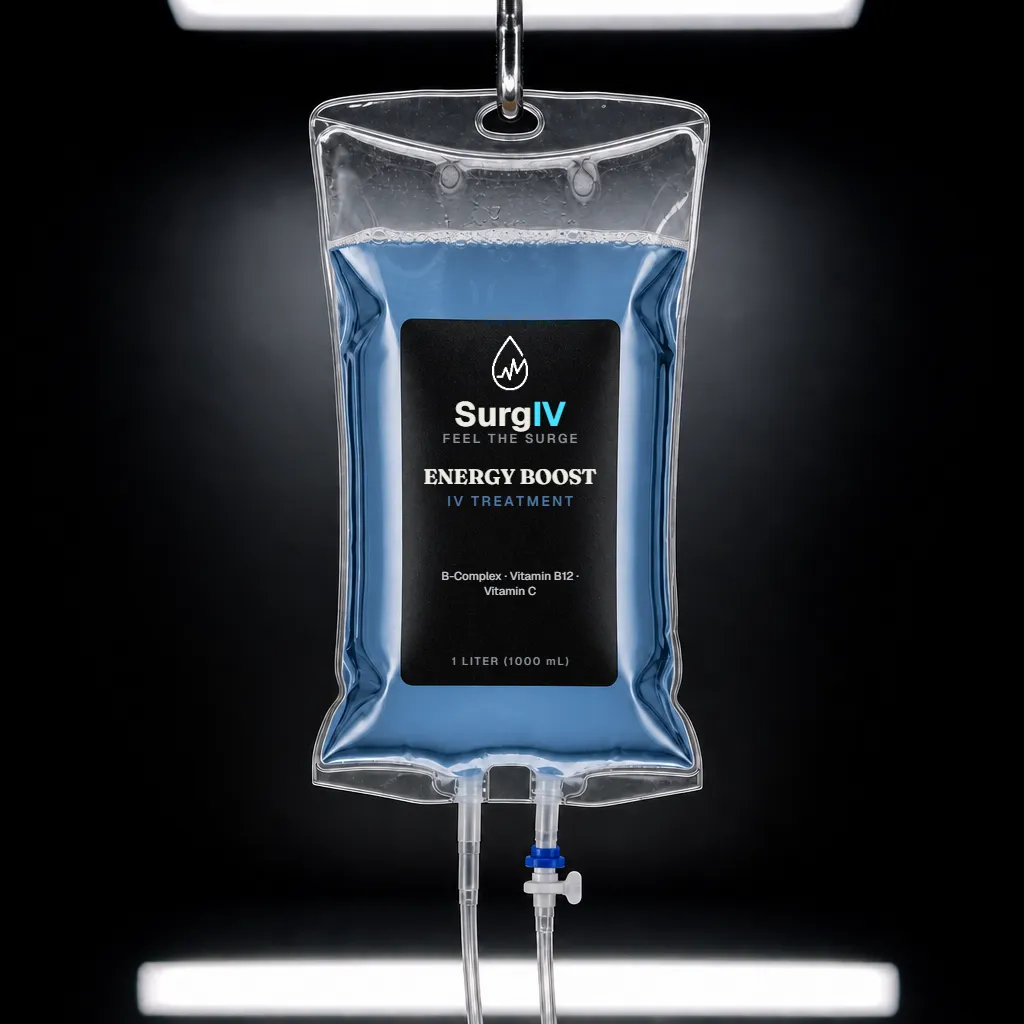
The whole family, full dose
Energy Boost $249
B-complex plus B12 delivered at 100% — the energy payroll, funded.
B-Complex · Vitamin B12 · Vitamin C
Tour's end
Next label you read, the numbers will mean something: 1 converts, 2 shuttles, 3 becomes NAD⁺, 5 adapts, 6 synthesizes, 7 markets itself, 9 divides, 12 delivers. One energy economy, eight payroll lines, zero storage — fund it daily, restock it fully after the weeks that spend it hard, and give B2 a nod the next time the receipt shows up neon.
This article is for general education and is not medical advice. IV therapy at SurgIV is administered by registered nurses under physician-written protocols, with a health screening before your first visit. Talk to your doctor about what is right for you.