
It arrives around 2 PM, right on schedule. The morning's sharpness dissolves. You reread the same paragraph three times. Meetings turn into fog banks. So you reach for coffee number three, which buys you forty jittery minutes and a worse night's sleep — which guarantees tomorrow's fog arrives earlier.
High performers treat brain fog like a discipline failure. It almost never is. Your brain is the most metabolically expensive organ you own — roughly 2% of your body weight burning around 20% of your energy. When output drops, the first question isn't "what's wrong with my focus?" It's "what's my brain running on?"
The three supply lines that quietly fail
1. Water
Even mild dehydration — the kind you don't feel as thirst — measurably degrades attention and working memory. In South Florida, between the heat, the air conditioning, and the coffee (a diuretic), most professionals spend their afternoons in a low-grade fluid deficit that reads as mental dullness, not thirst.
2. B vitamins
The pathways that turn food into neural energy spend B vitamins the way an engine spends fuel — B12 and the B-complex family are cofactors in the exact chemistry that keeps neurons firing. They're water-soluble: your body doesn't stockpile them. Stress and caffeine accelerate the burn rate.
3. Cellular energy itself
Underneath both sits NAD⁺ — the coenzyme every mitochondrion needs to produce usable energy, and neurons are packed with mitochondria. NAD⁺ declines with age, and research links that decline to the drop in mental stamina people describe in their 40s that they never had in their 20s. The thinking isn't gone. The battery behind it is smaller.
Coffee doesn't add fuel. It hides the fuel gauge.
Why another coffee makes it worse
Caffeine works by blocking adenosine — the "you're tired" signal — not by supplying anything. The energy debt continues accumulating behind the blocked signal, then lands all at once when the caffeine fades. That's the 2 PM cliff: not a lack of stimulation, a margin call on real resources. Add caffeine's diuretic effect and its half-life wrecking tonight's deep sleep, and coffee three is actively financing tomorrow's fog.
Resupplying instead of stimulating
This is the reasoning behind The Surge: instead of masking the fatigue signal, restock what the signal is complaining about — intravenously, so absorption isn't the bottleneck.
- A liter of fluids and electrolytes clears the hidden hydration deficit in one sitting.
- B-complex and B12 replenish the cofactors your neural energy pathways spend daily.
- Amino acids support neurotransmitter production and steady energy metabolism.
- Glutathione supports clearing the oxidative stress that accumulates in high-output brains.
- NAD⁺ (500mg) addresses the deepest layer — the coenzyme your mitochondria actually run on.
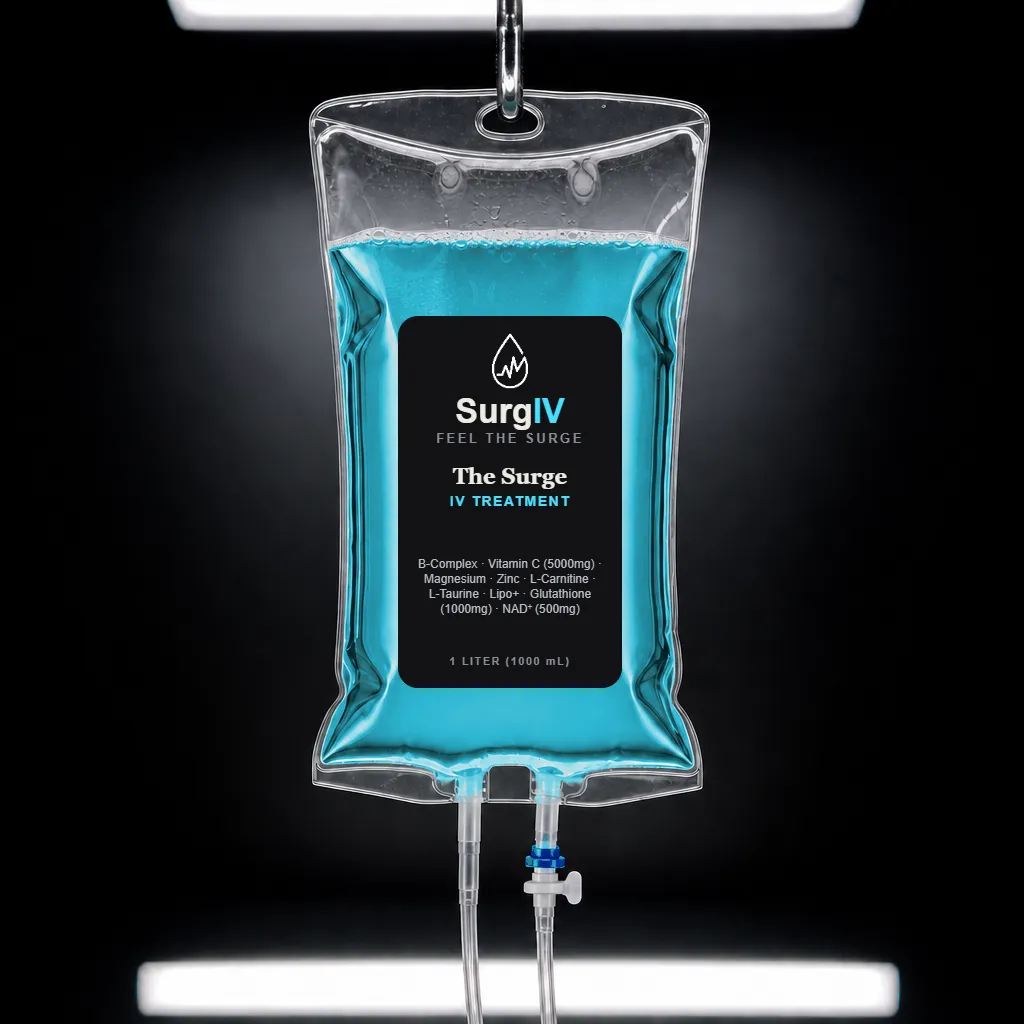
Clear-headed is a supply chain, not a willpower issue.
The Surge $899
Hydration, B-complex, amino acids and 500mg NAD⁺ — the inputs your focus actually runs on, delivered at 100% availability.
IV Bag: B-Complex · Vitamin C (5000mg) · Zinc · Magnesium · L-Carnitine · L-Taurine · Lipo+ + more
What changed for our members
The report we hear most isn't "I felt a rush." It's quieter and more valuable: the afternoon stopped falling apart. The 2 PM meeting got the same brain as the 9 AM one. One member told us she stopped blaming her age — "turns out I wasn't old, I was running on empty."
A session takes 60–90 minutes wherever you are — home, office, club — administered by a registered nurse under physician-written protocols. Most of Palm Beach County can book same-day. If your afternoons are where your best work goes to die, the fix probably isn't a fourth coffee.
This article is for general education and is not medical advice. IV therapy at SurgIV is administered by registered nurses under physician-written protocols, with a health screening before your first visit. Talk to your doctor about what is right for you.