
The question came from a member we'll call Frank — the same Frank from the vitamin D story, now a connoisseur of his own bloodwork — mid-Surge-session, reading the formula card: "Okay, B12 I get, D3 we've litigated. What's the third shot? Co-Q-ten? My cardiologist mentioned it when he started my statin and then the appointment ended. It's been bothering me for a year."
Frank's cardiologist, like most, half-mentioned one of biochemistry's more interesting stories. The full version, engine room first.
The spark plug in the power plant
Every energy story on this blog runs through the mitochondria — the NAD⁺ saga, the B-vitamin payroll — and CoQ10 (coenzyme Q10, ubiquinone to chemists) is the chain's literal final-assembly component: a required electron carrier in the transport chain where ATP actually gets minted, plus a fat-soluble antioxidant protecting those same power plants from their own exhaust. The concentration map tells you its priorities: highest in the heart (the never-resting muscle), then skeletal muscle and brain — the tissues with the biggest energy bills. And like every molecule in this genre: the body makes its own, and production declines with age — the familiar curve, applied to the spark plugs.
NAD⁺ funds the power plant. The B vitamins staff it. CoQ10 is the component the final assembly line can't run without.
The statin story (told properly)
Here's what Frank's cardiologist half-mentioned: statins — the most prescribed drug class in the county's demographic — block cholesterol synthesis at an enzyme (HMG-CoA reductase) that sits on the same pathway the body uses to synthesize CoQ10. Result: statin therapy measurably lowers CoQ10 levels — a clean biochemical fact. The clinically debated part: whether that depletion drives the muscle aches some statin users report, and whether supplementing helps — the research is genuinely mixed, which is why the conversation exists without a verdict. The non-negotiable frame, stated the way Frank's cardiologist would want: statins are life-extending medicine and their management belongs to cardiologists — CoQ10 is a conversation to have with the prescriber, never a workaround, and absolutely never a reason to self-adjust a heart medication. What the wellness side can honestly offer is the supply layer, discussed openly with the doctor driving.
The absorption problem (and the shot answer)
CoQ10's practical challenge is the aisle's dirty secret: it's a large, fat-soluble molecule with notoriously poor and variable oral absorption — the softgel's label dose and the bloodstream's received dose diverge widely, brand roulette included. Which is why its delivery in our menu follows the depot logic: CoQ10 rides as the third member of the Surge's IM shot trio — alongside B12 (the broken-pathway vitamin) and D3 (the sunshine paradox) — the three molecules whose oral routes struggle most, delivered as slow-release deposits that skip the gut's opinions entirely. The engine-room stack, completed: NAD⁺ in the bag, spark plugs in the shot.
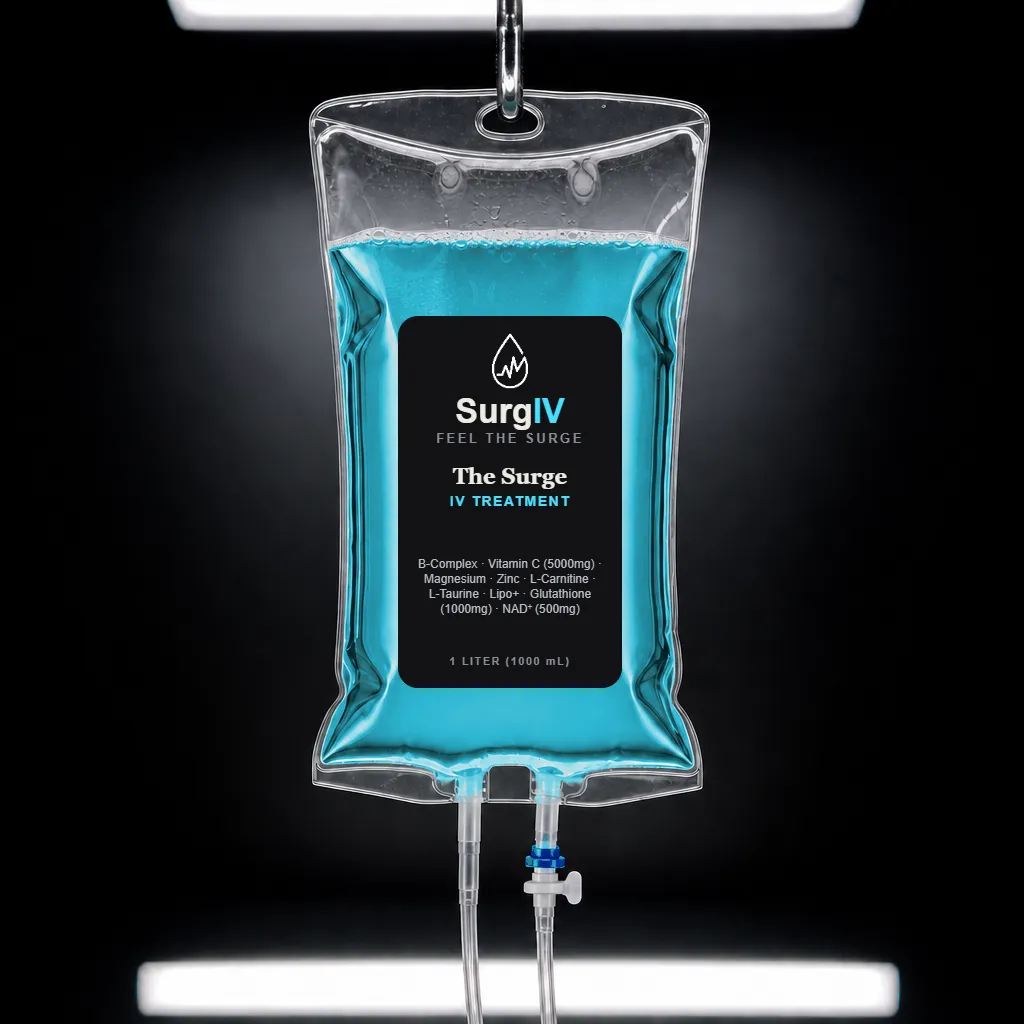
The IM shot trio's third member
The Surge $899
CoQ10 rides with B12 and D3 in the Surge's shots — the fat-soluble depot approach.
IV Bag: B-Complex · Vitamin C (5000mg) · Zinc · Magnesium · L-Carnitine · L-Taurine · Lipo+ + more
Frank, fully briefed
Frank took the article to his next cardiology appointment — of course he did — and returned with a doctor-approved plan and a review: "He said, quote, 'that's a fair summary and please keep taking the statin.' Both achieved. Also he asked for your number, which I'm counting as my bloodwork's greatest victory." The year-long bother, resolved. The spark plugs, funded. The cardiologist, driving — exactly as designed.
This article is for general education and is not medical advice. IV therapy at SurgIV is administered by registered nurses under physician-written protocols, with a health screening before your first visit. Talk to your doctor about what is right for you.