
The calendar says back-to-back from 7 to 7. The inbox regenerates faster than you clear it. Somewhere around Thursday you notice the thing you don't say out loud: you're running the most demanding operation of your life on the least energy you've ever had.
The business press will sell you burnout as a psychology problem — set boundaries, practice gratitude, download a breathing app. Fine advice. But there's a layer underneath the psychology that almost nobody addresses, and it's stubbornly physical: chronic high output consumes things. Actual molecules. And most executive schedules are consumption machines with no resupply plan.
What a high-output week actually burns
- Hydration. Coffee at 7, meetings until 6, wine at dinner — a diuretic sandwich with almost no water in it. Mild dehydration degrades focus and mood before you ever feel thirsty.
- B vitamins. Stress hormones are expensive to produce, and the pathways that make them — and that turn food into mental energy — spend B vitamins constantly. They're water-soluble; you don't store them, you either replace them or run short.
- Magnesium. Involved in hundreds of enzymatic reactions including the ones that regulate stress response and sleep quality. Chronic stress accelerates its loss.
- Antioxidant capacity. High metabolic output produces oxidative stress. Glutathione — your body's master antioxidant — is the cleanup crew, and demand outruns supply in exactly the lifestyle you're living.
- NAD⁺. The coenzyme your cells use to produce energy at all. It declines with age on its own; sustained stress adds demand on top of the decline. This is the deep end of the deficit — the reason everything feels more expensive at 48 than it did at 34.
You'd never run a company the way you run your body: maximum output, zero replenishment, and a plan to "push through" the supply gap.
Why the usual executive fixes miss
More coffee blocks the fatigue signal without funding anything — a payday loan against tomorrow. The productivity system reshuffles demand without touching supply. Even the vacation mostly pauses the drain rather than refilling the tank — which is why you're exhausted again nine days after getting back.
The move that actually changes the equation is boring and physical: put the consumed resources back, at full dose, on a schedule as reliable as the one draining them.
A 75-minute meeting with your own energy budget.
The Surge $899
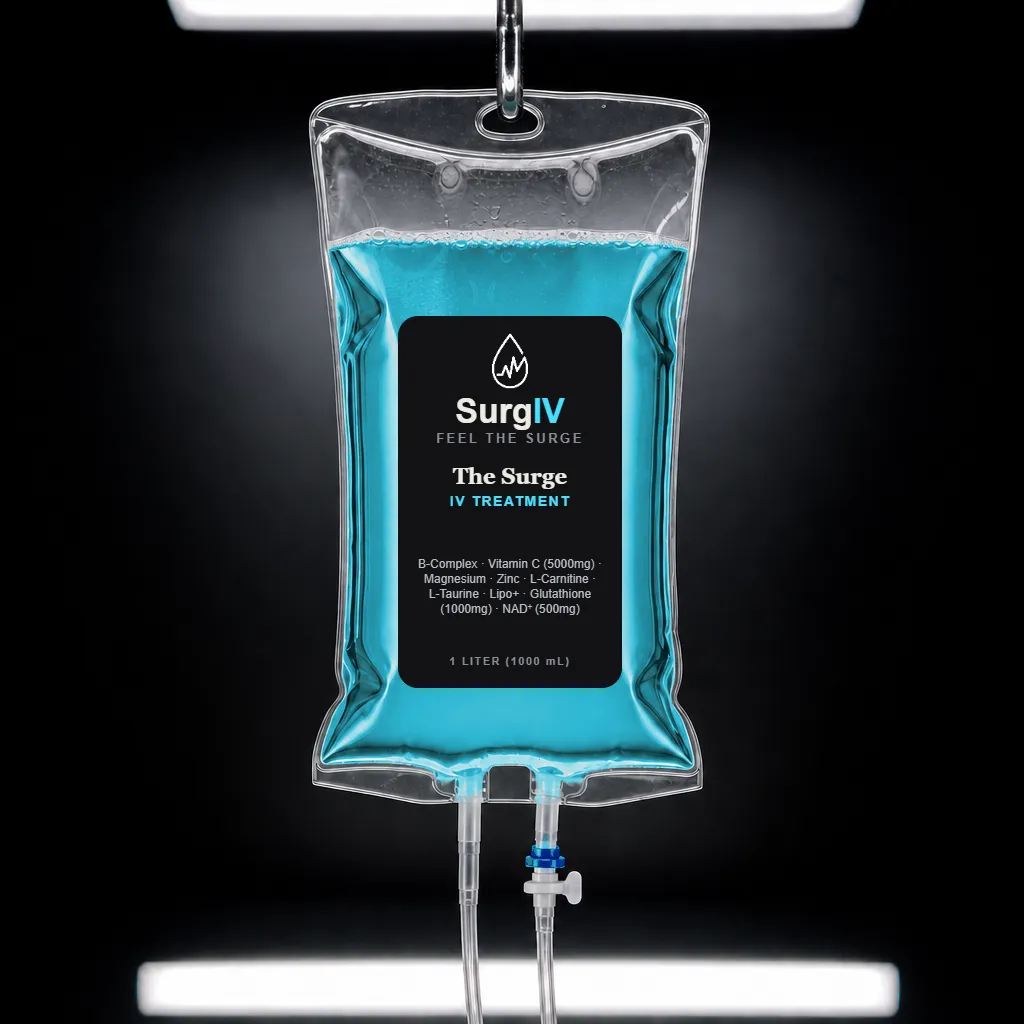
The Surge comes to your home or office — hydration, B vitamins, aminos, glutathione and 500mg NAD⁺, administered by an RN while you take calls.
IV Bag: B-Complex · Vitamin C (5000mg) · Zinc · Magnesium · L-Carnitine · L-Taurine · Lipo+ + more
The concierge part matters more than you'd think
The reason executives don't fix this isn't skepticism — it's friction. Nobody with your calendar is driving to a drip bar to sit in a vinyl chair for two hours. So The Surge removes the friction entirely: a registered nurse arrives at your home or office, sets up in minutes, and administers the full formula — a liter of fluids, B-complex, vitamin C, zinc, magnesium, amino acids, 1000mg glutathione, 500mg NAD⁺, plus B12, D3 and CoQ10 shots — while you keep working. Sixty to ninety minutes later the only evidence is that you feel like a different quarter of your life.
What members report
The pattern isn't euphoria — it's margin. Afternoons that hold. Decisions that don't feel like lifting. One member described it as getting back "the version of me my team was promised." Another stopped scheduling around his own energy dips because they stopped being load-bearing.
Burnout recovery has a psychological layer, and we'd never pretend otherwise. But you cannot mindset your way out of a materials shortage. Refill the tank first — then see how much of the "burnout" was really just the gauge on empty.
This article is for general education and is not medical advice. IV therapy at SurgIV is administered by registered nurses under physician-written protocols, with a health screening before your first visit. Talk to your doctor about what is right for you.