
At his 60th birthday dinner, a member we'll call Robert — the same Robert from our testimonials who's "training harder than he has in years" — fielded the table's standard toast question: "So, planning to live to a hundred?" His answer stopped the table, and it's the best two-sentence summary of this article we've heard: "Wrong question. I'm planning to water-ski at eighty-five — however long I live after that is gravy."
Robert has, knowingly or not, articulated the most important distinction in modern aging science — one that reorganizes every health decision you'll make from here: lifespan versus healthspan.
The two numbers, and the gap between them
Lifespan is the count everyone tracks: years alive. Healthspan is the count that determines what those years contain: the stretch you spend capable — free of major disease and disability, able to travel, play, lift grandchildren, water-ski. Here's the statistic that reframes everything: in the developed world, the gap between the two averages roughly a decade — ten-ish final years of diminished function that nobody plans for and everybody fears. Which means the modern longevity project, properly understood, was never really about adding years at the end. It's about shrinking the gap — a goal the research literature calls compression of morbidity: pushing serious decline so late that the unhealthy period compresses into a brief final chapter. Long plateau, short slide. Robert's water-ski plan, in technical language.
"I'm planning to water-ski at eighty-five. However long I live after that is gravy." — healthspan, defined at a birthday dinner
Why the distinction changes your decisions
Optimizing for lifespan alone is mostly defensive medicine — screening, risk management, not dying of the big things. Necessary, insufficient. Optimizing for healthspan adds the offensive game: building and defending capability — the muscle, cardiovascular capacity, balance, energy and cognition that determine what age 75 actually feels like. And capability's research podium is stubbornly unglamorous: exercise towers over everything (strength training especially — see the muscle story — with VO2max and even grip strength ranking among the strongest predictors of capable aging in the literature); sleep (the free drug); metabolic health; not smoking; and — underrated by every biohacker — social connection and purpose, whose effect sizes embarrass most supplements. The compression play is mostly these levers, pulled consistently for decades.
Where the supporting cast fits (our lane, honestly marked)
So where does anything we sell fit a healthspan strategy? In the supply chain under the levers — and we'll keep the claim exactly that size. The #1 lever is training, and training runs on recovery: the widening recovery window is what quietly retires most people from the capability game in their 50s, and the NAD⁺ decline is part of that story's machinery. Supporting the recovery that keeps you lifting, the cellular energy the decades tax, the hydration and micronutrient floor that makes every healthy behavior easier — that's the honest job description of The Surge in a healthspan portfolio: maintenance crew, not miracle. The levers build the plateau. The supply line keeps the builders showing up.
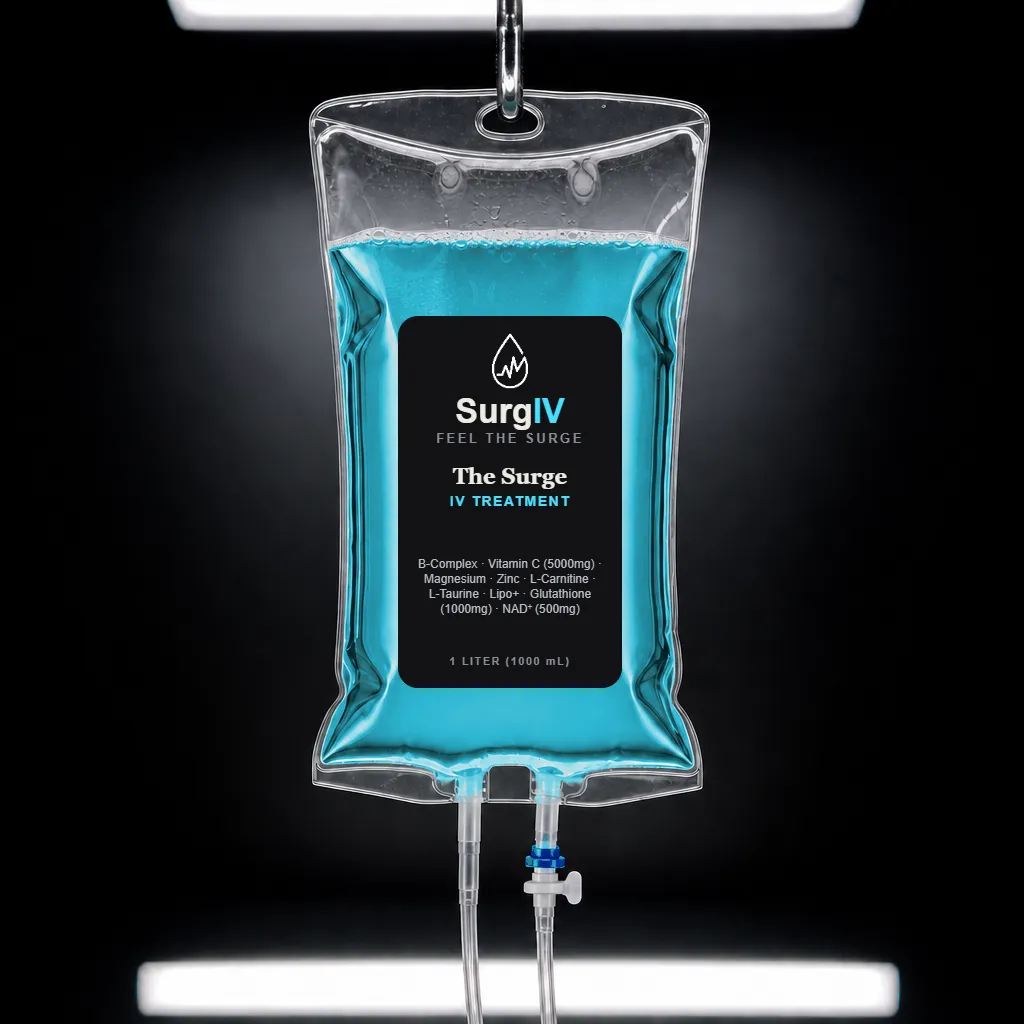
The healthspan project's supply line
The Surge $899
NAD⁺, glutathione and the full formula — maintenance for the years you intend to use.
IV Bag: B-Complex · Vitamin C (5000mg) · Zinc · Magnesium · L-Carnitine · L-Taurine · Lipo+ + more
Robert's portfolio
For the record, Robert's actual regimen — strength training three days, tennis two, sleep guarded "like a Fabergé egg," monthly Surge as the recovery anchor, and a social calendar his wife describes as "unretirable" — is a textbook compression portfolio, assembled by instinct. The water-ski goal has a date (his 85th, lake already chosen), the gap-shrinking project is two decades deep, and his birthday-dinner philosophy scales to everyone reading this: stop counting the years. Start provisioning what you plan to do in them.
This article is for general education and is not medical advice. IV therapy at SurgIV is administered by registered nurses under physician-written protocols, with a health screening before your first visit. Talk to your doctor about what is right for you.