At least once a week, our dispatch takes a call that starts like this one from last month — a first-timer in Palm Beach Gardens, morning after her daughter's wedding: "I don't understand. I've been doing IV all weekend and I still feel terrible." A few questions in, the picture clears: she'd been stirring packets into water bottles. Sixteen of them, by her count. She had not, in the intravenous sense, "done IV" at any point in her life.
She's not silly — she's a victim of the most successful naming decision in beverage history. The best-selling hydration packets literally carry "I.V." in the brand, the categories have blurred completely, and half the people who think they've tried IV therapy have tried a drink. So let's un-blur it, fairly — because both products are good at their actual jobs.
What the packets really are (and the real science inside)
Hydration multipliers are oral electrolyte mixes built on a genuinely clever, decades-old piece of physiology: sodium-glucose co-transport. Pair sodium with a little glucose in the right ratio and your gut pulls water through its wall measurably faster than plain water manages — the same principle behind the WHO's oral rehydration solution that has saved millions of lives in cholera zones. The marketing translates this as "hydrates 2–3x faster than water alone," and directionally, for the absorption step, that's fair. So credit where due: as beverages go, they're smart ones, and for daily maintenance they're a legitimate upgrade — we've said so before.
What the name skips over
Here's what no packet can change: it's still a drink. Everything in it enters through your gut — the same rate-limited, nausea-gateable, half-liter-an-hour door as every other beverage. "Multiplying" absorption efficiency doesn't remove the door; it oils the hinges. Which means all three of drinking's hard walls still apply: the rate wall against multi-liter deficits on deadlines, the gut wall when nausea has barricaded the route, and the volume reality that sixteen packets across a rough weekend still delivered fluid only as fast as one overwhelmed digestive tract allowed.
The packet borrowed the name of the one technology that doesn't have its limitations. Great branding. Confusing category.
What the actual IV is
Intravenous therapy is a different route into the body entirely: a sterile liter of fluids and electrolytes delivered into a vein by a registered nurse under physician protocols — no gut, no ceiling, no permission required from a nauseous stomach. A full liter lands in circulation during the session itself, with nutrient doses (real gram-level C, intact glutathione) that oral products physically cannot deliver at label strength. It costs more because it's a clinical service, and it earns that cost only in the situations that are its actual territory.
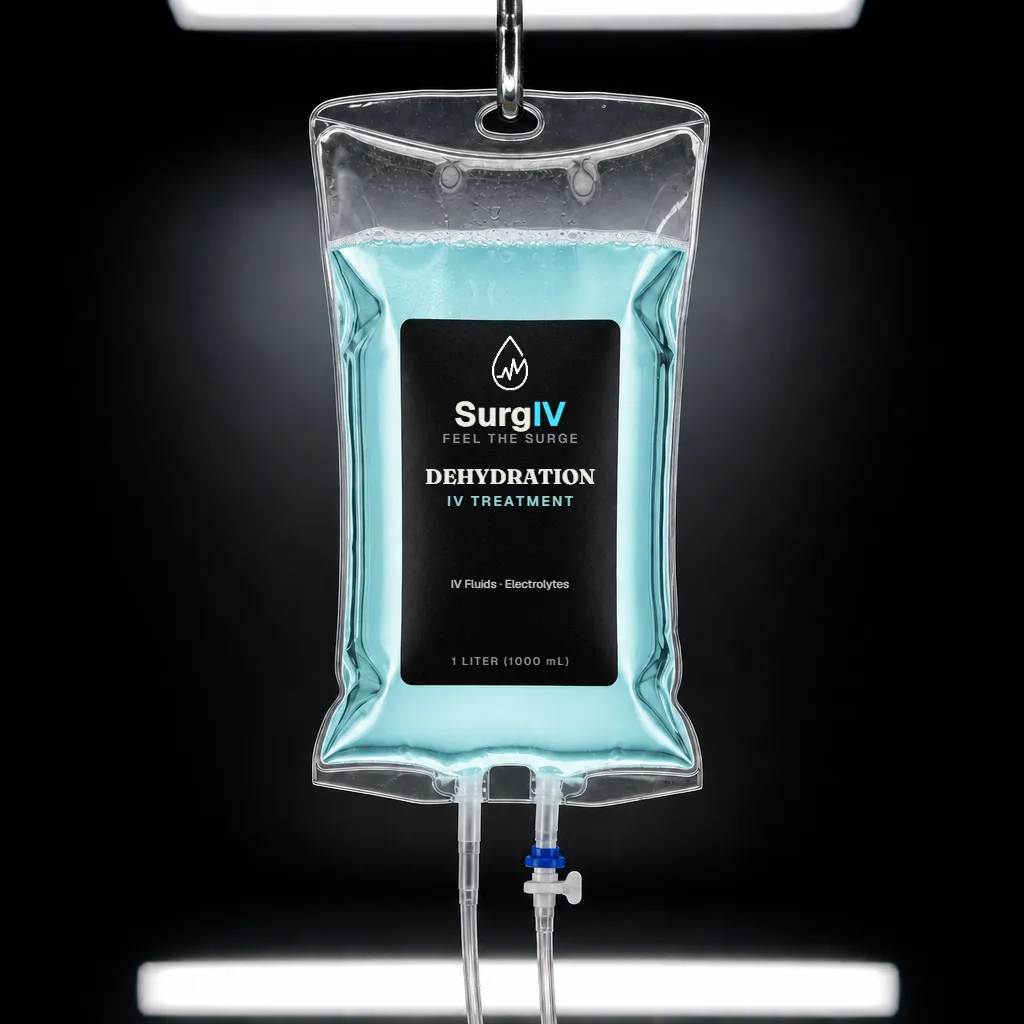
The actual IV
Dehydration $199
Not a drink with clever branding — a liter in your bloodstream, administered by a registered nurse.
IV Fluids · Electrolytes
How the wedding-weekend caller's story ended
A nurse reached her by 11:30. One actual liter later — her first true IV, sixteen packets notwithstanding — she called back to rebook for her husband, opening with the line we've since stolen for training new dispatchers: "Okay. The packets are coffee creamer. THAT was the coffee." Keep the packets in the pantry; they're good at their job. Just know which product owns the name — and which one owns the category the name describes.
This article is for general education and is not medical advice. IV therapy at SurgIV is administered by registered nurses under physician-written protocols, with a health screening before your first visit. Talk to your doctor about what is right for you.