
Here's an opening you don't expect from an IV company: if this is an ordinary day and you're mildly thirsty, close this tab and drink a glass of water. It's free, it's effective, and anyone who tells you a $199 drip beats the tap for everyday hydration is lying to you for money.
Still here? Good — because the interesting question was never "which is better." It's "where exactly does drinking stop working?" That line is real, it's sharper than people think, and knowing where it sits will save you both wasted money on drips you didn't need and wasted days on deficits the tap couldn't touch.
Where drinking wins (most of the map)
Daily maintenance. Workout thirst. Desk-life dryness. The morning-after of a modest night. In all of these, oral water — ideally with food or a pinch of electrolytes doing the retention work — is the right tool: your gut absorbs it steadily, your kidneys manage the books, and the whole system was refined over a few hundred million years. The tap wins on cost, convenience, and physiology. This is 90% of hydration life, and we have no product for it besides the advice itself.
The three walls where drinking fails
The other 10% is defined by three hard limits — not preferences, physics:
- The rate wall. Your gut admits roughly half a liter to a liter per hour, period — chugging doesn't raise the ceiling. Against a 2–3 liter hole (boat day, heat exhaustion, illness) with a deadline (work, a flight, a tournament), drinking isn't slow — it's mathematically eliminated.
- The gut wall. Nausea from a bug, hangover, or food poisoning barricades the only door drinking uses. The cure requires the route the illness closed — the cruelest catch in home remedies.
- The retention wall. Deep deficits take sodium with them, and water without minerals partially just passes through — your kidneys can't hold water they have no salt to hold it with. Plain water on a big deficit is filling a bucket with a slow leak.
Drinking water is the right answer to almost every hydration question — except the three where it isn't, which are exactly the ones people search at 9 AM in crisis.
The decision rule
One question sorts every situation: "Can my gut close this gap before my deadline?" Small gap or no deadline: tap, maybe with electrolytes — enjoy the free option. Multi-liter gap, real deadline, or a gut that's refusing deliveries: that's the Dehydration IV's entire reason for existing — the full liter with balanced minerals, delivered past all three walls, in one at-home session. Not better water. Water through a different door, for the days the main door is blocked or too slow.
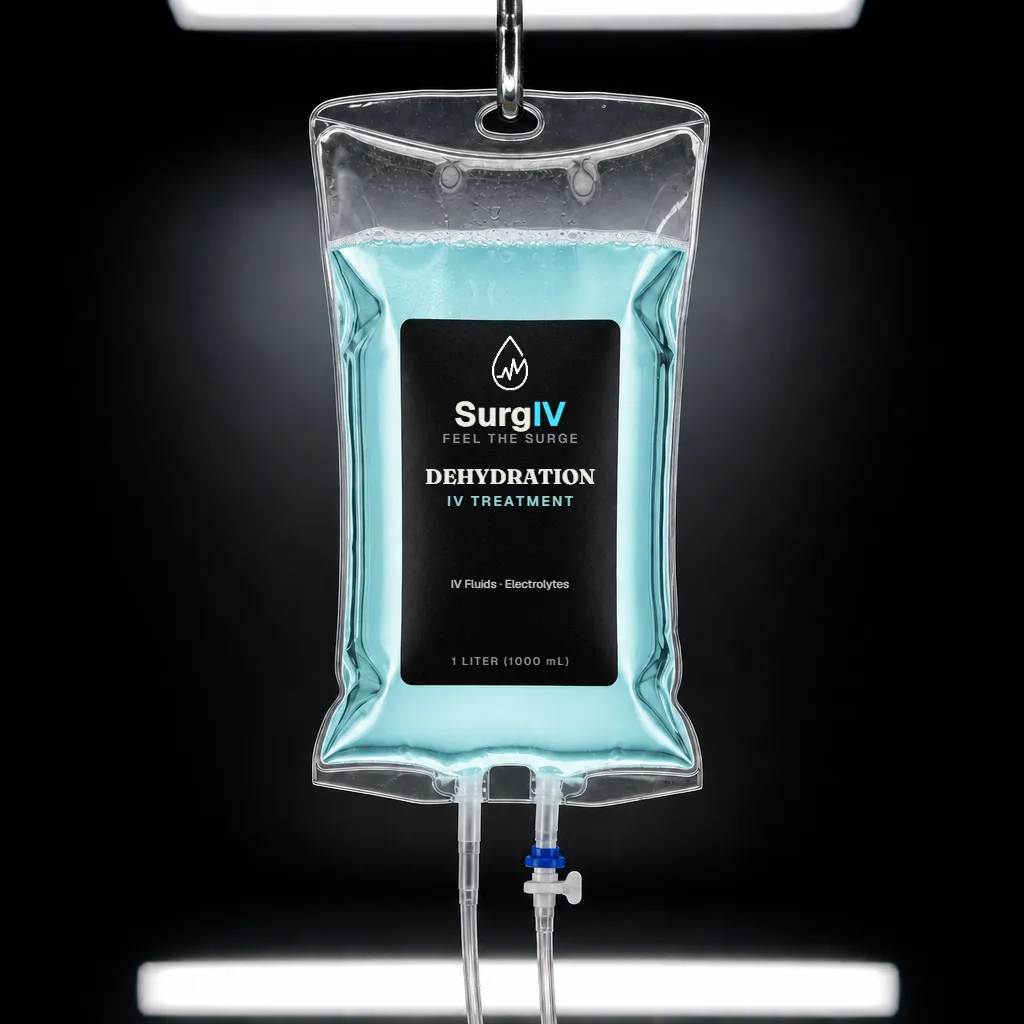
For the ten percent
Dehydration $199
A full liter direct to circulation — for the deficits drinking can't close in time.
IV Fluids · Electrolytes
The honest summary
We sell the drip and we're telling you: the tap is undefeated in its territory, and its territory is most of life. Respect the free option, use the electrolyte upgrade when you're sweating hard, and save us for the three walls — where we're not competing with drinking water at all, because drinking water was never an option in the first place. That's the whole map. Now go have a glass.
This article is for general education and is not medical advice. IV therapy at SurgIV is administered by registered nurses under physician-written protocols, with a health screening before your first visit. Talk to your doctor about what is right for you.