
Sunday, 2 PM, a group chat in Boynton Beach. The message: "Guys. Wrecked from yesterday. Like REALLY dehydrated. Urgent care or that IV thing? Someone decide for me, I can't." The responses split immediately — the sister-in-law who works in healthcare votes urgent care, the golf buddy votes the house call, and the original poster lies on the bathroom floor awaiting a verdict.
It's a genuinely good question with a genuinely knowable answer — and because we're one of the two options, we'll draw the line with extra care, including the territory where urgent care wins and it isn't close.
The question under the question
Strip it down and the decision is one distinction: do you need treatment, or do you need evaluation? If you know what happened — the boat day, the golf marathon, the night out, the stomach bug running its known course — and what you need is fluids you can't drink fast enough, that's treatment territory: the deficit is the diagnosis. If you don't know why you feel this way, if symptoms don't match the story, or if the person is vulnerable (very young, elderly, chronically ill) — that's evaluation territory, and evaluation needs labs, imaging, and a physician. Urgent care's waiting room is the price of its diagnostic machinery. Our doorbell is the convenience of not needing it. Choosing correctly means knowing which one today is.
Known cause + fluid deficit = treatment problem. Unknown cause or vulnerable person = evaluation problem. The venue follows the problem.
Urgent care's territory (respect it)
Send the group chat to urgent care or the ER, without debate, for: confusion or acting 'off,' fainting, chest pain, breathing trouble, no urination in 8+ hours (dehydration past the wellness line), severe or localized abdominal pain, blood anywhere, high fever, or symptoms in infants and the frail elderly. Also: dehydration that keeps recurring without explanation — that's a workup, not a rehydration schedule. This list is lifted from our own refusal protocols, because our nurses screen for exactly these and redirect when they appear. A wellness company that would rather treat you than triage you is the industry's most dangerous product.
The house call's territory
For everything below that line — the known-cause, miserable-but-stable dehydration that is most of real life — the comparison gets lopsided: time (an hour on your couch versus 2–4 in a waiting room, feeling like this); exposure (your living room versus the seasonal petri dish of urgent-care seating — a particular irony when you're depleted); cost clarity (a flat $199 versus the copay-plus-mystery-coding lottery); and the same core treatment — a liter with electrolytes is a liter with electrolytes; ours just arrives with RN screening instead of a registration desk. What you give up is the diagnostic infrastructure — which, in known-cause territory, was never the need.
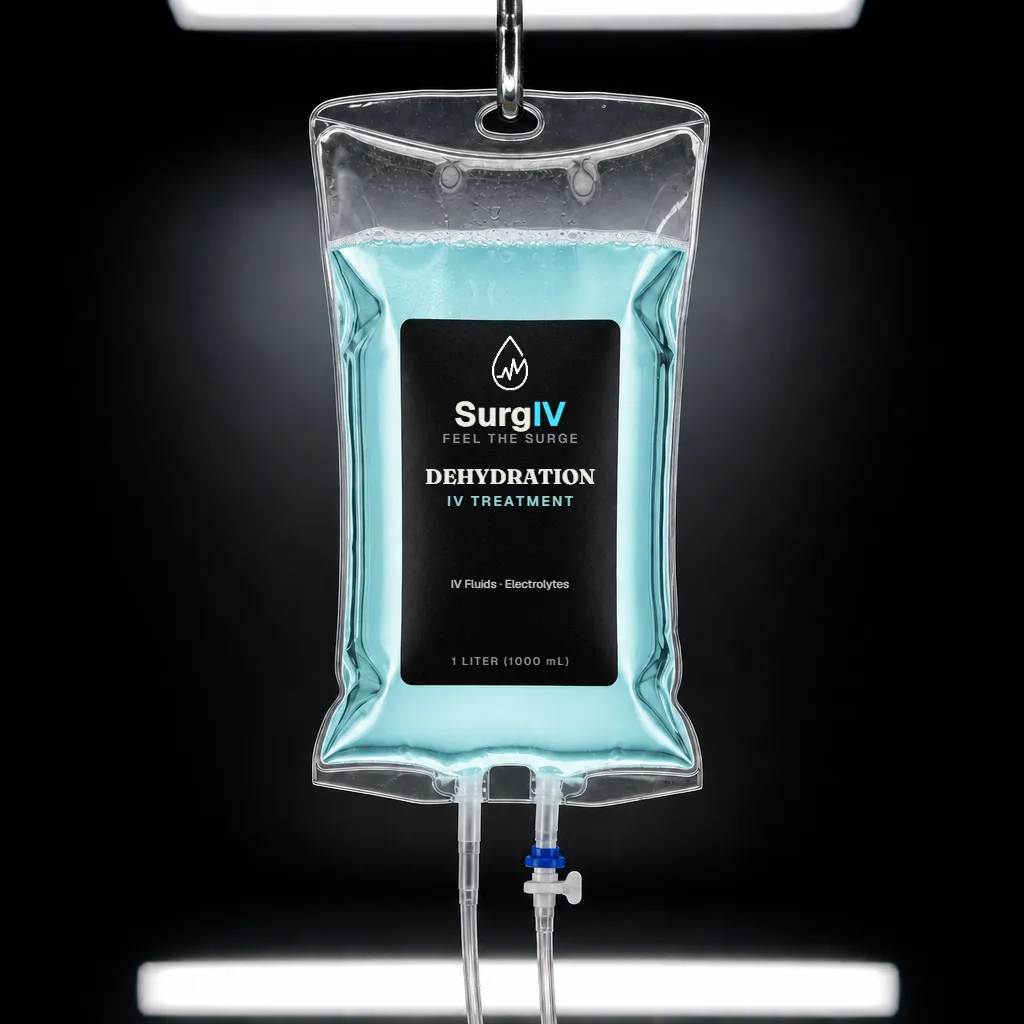
The doorbell option
Dehydration $199
For wellness-grade dehydration — a nurse, a liter, your couch, no waiting room.
IV Fluids · Electrolytes
The group chat, resolved
The bathroom-floor correspondent, for the record, had a known cause (a documented sandbar Saturday), no red flags, and a functioning doorbell — the nurse arrived at 3:40, ran the screening, confirmed the obvious, and had him upright for Sunday dinner. The sister-in-law's healthcare instincts weren't wrong; they were just calibrated for the other territory. Both venues are right — about different problems. Now you know which problem you're having before you ask the group chat.
This article is for general education and is not medical advice. IV therapy at SurgIV is administered by registered nurses under physician-written protocols, with a health screening before your first visit. Talk to your doctor about what is right for you.