
Tuesday night, 8:40 PM, an academy in Lake Worth. The technique portion is over; the rolling has begun. A 44-year-old purple belt we'll call Marcus — software architect by day, mat rat by conviction — is in round four of five, inside a 24-year-old blue belt's closed guard, in a gi that now weighs approximately eleven pounds, in a room where the AC surrendered around round two. Marcus escapes, survives, even sweeps. The round ends. He walks to the wall, leaves a handprint of sweat on it, and has the thought every hobbyist grappler over 40 has weekly: "I have never loved anything this much that wanted me dead."
The gentle art's ungentle math
BJJ's physical ledger is unique in recreational sport: the sweat rate — a gi is insulation, grappling is continuous full-body isometric output, and a hard hour costs 2–5 pounds of fluid (weigh in and out once; the number changes people) — among the highest mineral-loss rates in any sport, indoors or out. The grip-and-frame bill — forearms, hands and neck run near-constant tension no gym lift replicates; the night cramps of a heavy training week are the invoice. The compression economy — being crushed, framed on and escaped from is load-bearing work your muscles log even when you "just defended all night." And the age asymmetry Marcus lives: the 24-year-old across from him trains daily and rebuilds overnight; Marcus's rebuild, per the over-40 recovery math, runs on a longer clock with a smaller budget — same mats, different physics.
"I have never loved anything this much that wanted me dead." — every over-40 grappler, round four, forever
The longevity protocol (rolling for decades)
The tribe's veterans converge on the same system: rehydrate by the scale, not by feel — the post-roll weigh-in sets the debt (every pound ≈ half a liter plus minerals), and settling it same-night decides tomorrow's energy; tap early, always — ego is the sport's actual injury mechanism, and the joint you save is the career you keep; pick your wars — technique nights and chosen partners over nightly shark tanks after 40; fund the rebuild deliberately — the Recovery IV after the week's hardest block (Thursday wars, Saturday open mats): full fluids against the gi's tax, aminos for the compression economy, magnesium for the grip-cramped forearms. Competition weeks run the standard 48-hour protocol — and on weight cuts, our position costs us bookings and stays anyway: dramatic dehydration cuts degrade everything competition demands and can't be fully rehydrated by mat time. Compete at walking weight. The art is supposed to be for life; cut protocols borrow against exactly that.
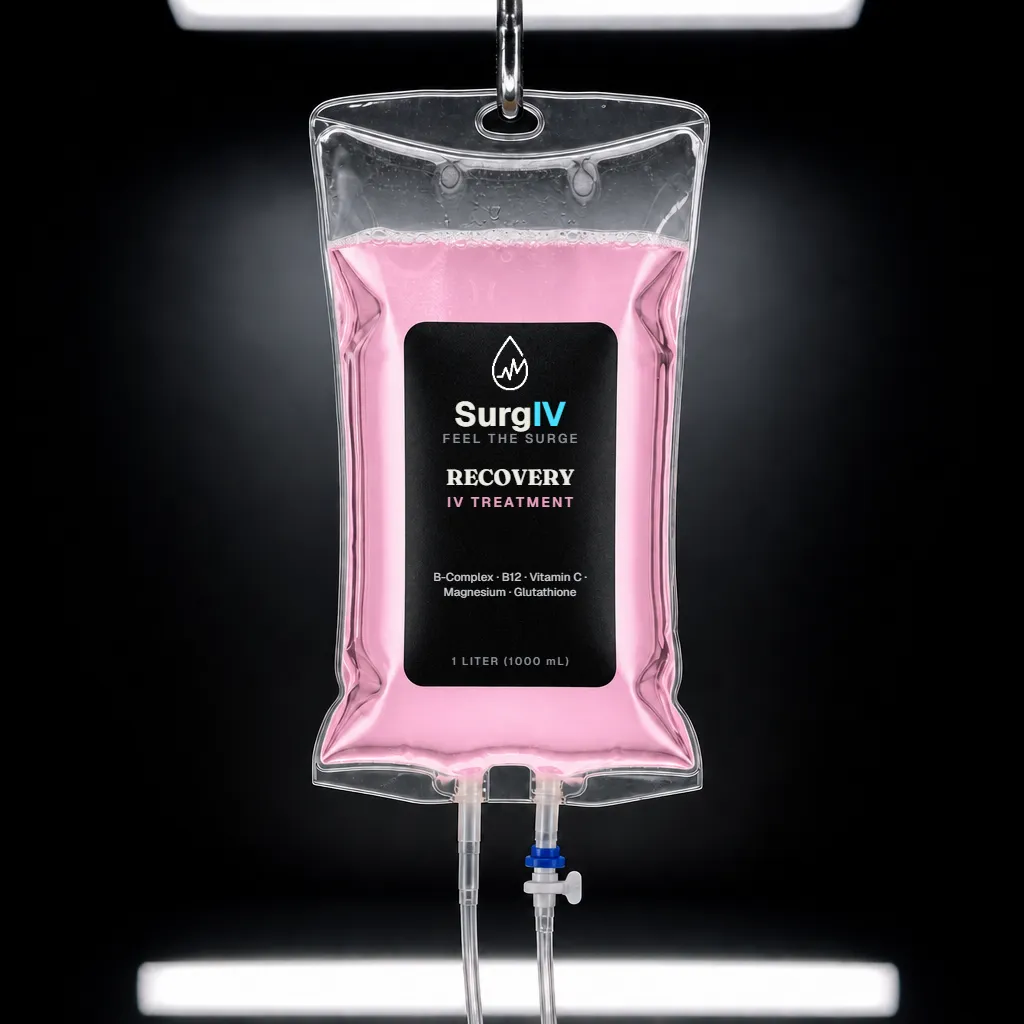
Between the wars
Recovery $299
Fluids, aminos and minerals after the hard rounds — so Thursday's rolls get Tuesday's gas tank.
B-Complex · B12 · Vitamin C · Magnesium · Glutathione
Marcus, still rolling
Marcus's current system: Thursday-night wars, Friday-morning drip (a standing 7 AM before work — "the only appointment where I'm allowed to lie still"), the scale ritual after every session, and a tap threshold his younger self would mock and his shoulders thank. He got his brown belt in March, at 45, upright and un-retired. His summary belongs on the academy wall: "Jiu-jitsu is a thirty-year conversation. Recovery is how you stay in the room."
This article is for general education and is not medical advice. IV therapy at SurgIV is administered by registered nurses under physician-written protocols, with a health screening before your first visit. Talk to your doctor about what is right for you.