
A member in Jupiter — call him Paul, 51, finance, self-described "sleep optimization guy" — arrived at his first session with data. Actual data: a wearable ring, two years of sleep scores, and a graph he showed our nurse the way other men show fishing photos. His frustration, summarized: "My sleep hygiene is perfect. Cold room, no screens, magnesium, the works. Scores are decent. So why do I still wake up feeling like the battery only charged to 70?"
It's a great question with an under-asked answer: sleep is when recovery happens, not what recovery is made of. The night shift still needs supplies — and Paul had spent two years optimizing the shift schedule while the warehouse quietly emptied.
The loop, mapped
Direction one: bad sleep drains NAD⁺. Short or shallow sleep raises cellular stress, and the cleanup — DNA repair especially — is run by enzymes (PARPs) that are among the body's heaviest NAD⁺ consumers. Chronic under-sleeping is chronic overdraft on the cellular energy account. Direction two: low NAD⁺ degrades what sleep can accomplish. The overnight repair program — muscle rebuild, memory consolidation, the glymphatic rinse — is active metabolic work, funded by the same declining coenzyme. Eight hours with a depleted supply line is the night shift showing up to an empty warehouse: hours logged, work unfinished, and a 6 AM report that reads "charged to 70%." That's the loop: each side degrades the other, which is why "tired despite good sleep scores" is one of the most common sentences in our intake notes — and why it has two levers, not one.
Sleep is the shift. NAD⁺ is the inventory. Optimizing one while the other runs empty is half a fix.
Working both ends
The sleep lever — still first, always. We sell the other lever and we'll say it plainly: nothing on any menu replaces sleep, and the free protocols (consistent schedule, dark cool room, caffeine cutoff, alcohol honesty — it wrecks the deep stages) remain the highest-ROI health behaviors in existence. Paul had this lever fully pulled. That was the point: a fully-pulled sleep lever with a fading result is the signature of a supply problem.
The supply lever. This is where the Surge approach fits: 500mg NAD⁺ to restock the repair budget, magnesium (the sleep-quality mineral that stress spends), B vitamins and hydration — dehydrated sleep is measurably shallower sleep, a detail the Florida deficit makes locally relevant. The member-reported pattern over a rhythm of sessions is exactly what the loop predicts: not sedation, but mornings where the same sleep score finally pays out at full value — the battery charging to the number the ring was promising all along.
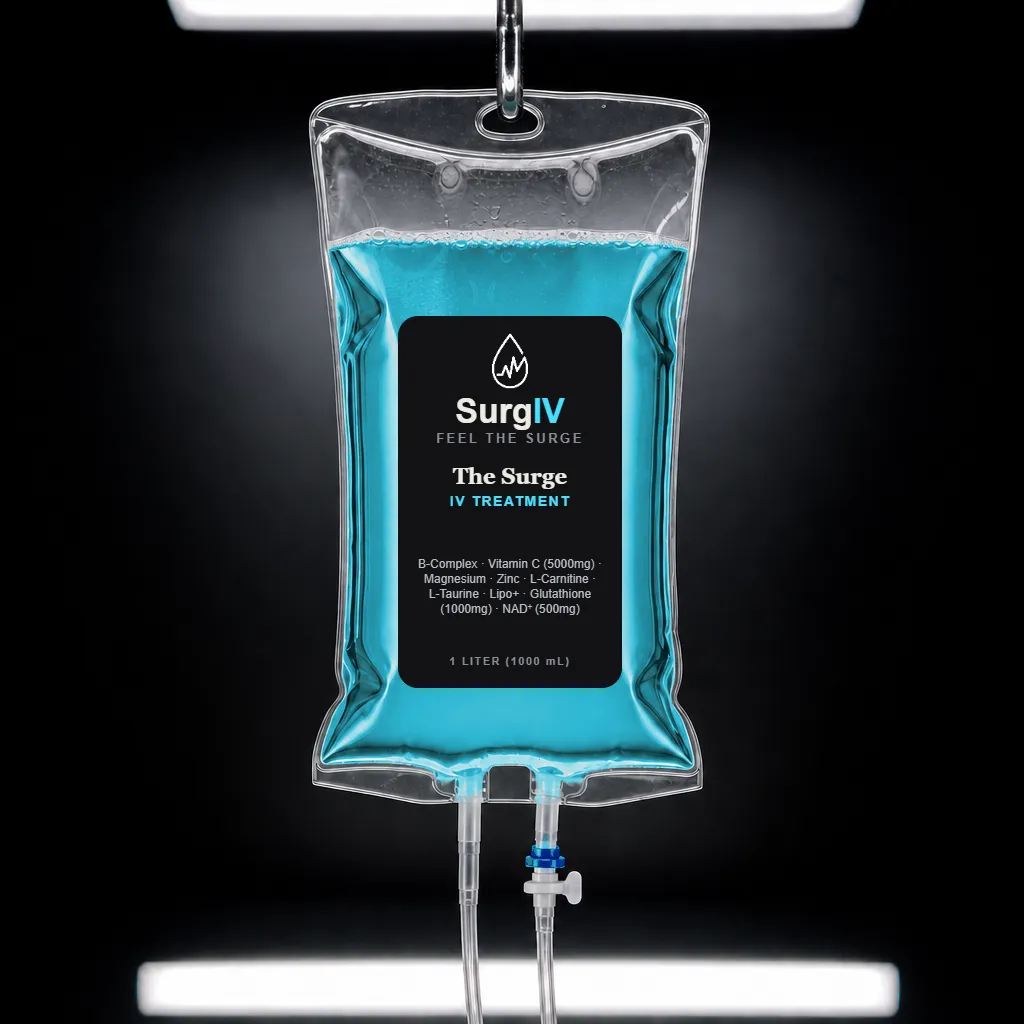
Fund the night shift
The Surge $899
500mg NAD⁺ plus magnesium and the full formula — supplies for the repair crew that works while you sleep.
IV Bag: B-Complex · Vitamin C (5000mg) · Zinc · Magnesium · L-Carnitine · L-Taurine · Lipo+ + more
Paul's graph, revised
Three months of monthly sessions later, Paul brought the ring data back — same scores, and his own annotation, which is the entire article in one line: "Sleep didn't change. What sleep BUYS changed." He remains insufferable about the graphs. We remain delighted to be on them.
This article is for general education and is not medical advice. IV therapy at SurgIV is administered by registered nurses under physician-written protocols, with a health screening before your first visit. Talk to your doctor about what is right for you.