
Here's a question that sounds philosophical but is actually biochemical: when caffeine makes you feel energized — where did the energy come from?
Sit with it a second, because the answer explains a decade of your afternoons: it didn't come from anywhere. Caffeine adds no energy to your system — not a calorie, not a cofactor, nothing a cell can spend. What it does is block the signal that reports fatigue. Adenosine — the molecule that accumulates as your cells spend energy — is your body's gas gauge. Caffeine doesn't refill the tank. It tapes over the gauge.
The loan-shark economics of stimulation
Taping over the gauge is genuinely useful — for a morning, a deadline, a drive. The trouble is what happens when it's your entire energy strategy: the adenosine keeps accumulating behind the blocked receptors, and when the caffeine clears, it all lands at once (the crash — see the 3 PM anatomy). Meanwhile tolerance builds within weeks — your brain literally adds receptors to route around the blockade — so the dose escalates. And the half-life quietly wrecks deep sleep, which is where actual energy restoration happens. Borrow, crash, escalate, sleep worse, borrow more: it's a payday loan with a rewards card.
Caffeine is a loan against energy you don't have, at an interest rate you pay tomorrow.
The other side of the ledger
Now the contrast. NAD⁺ isn't a signal-blocker — it's the coenzyme your mitochondria use to produce energy in the first place: the working molecule inside the reactions that turn food into ATP. It's also the resource that declines steadily with age, which is why the caffeine dependence tends to deepen through your 40s: the real capacity shrinks, so the borrowing grows to cover it.
Restoring NAD⁺ — 500mg delivered intravenously in The Surge, alongside the B vitamins its pathways spend and the hydration everything runs in — is the opposite intervention: it addresses the production side. Not a louder alarm; a bigger battery. Which is why the felt experience is so different: no buzz, no crash, just — in the recurring words of members — afternoons that stopped collapsing and a third coffee that stopped being load-bearing.
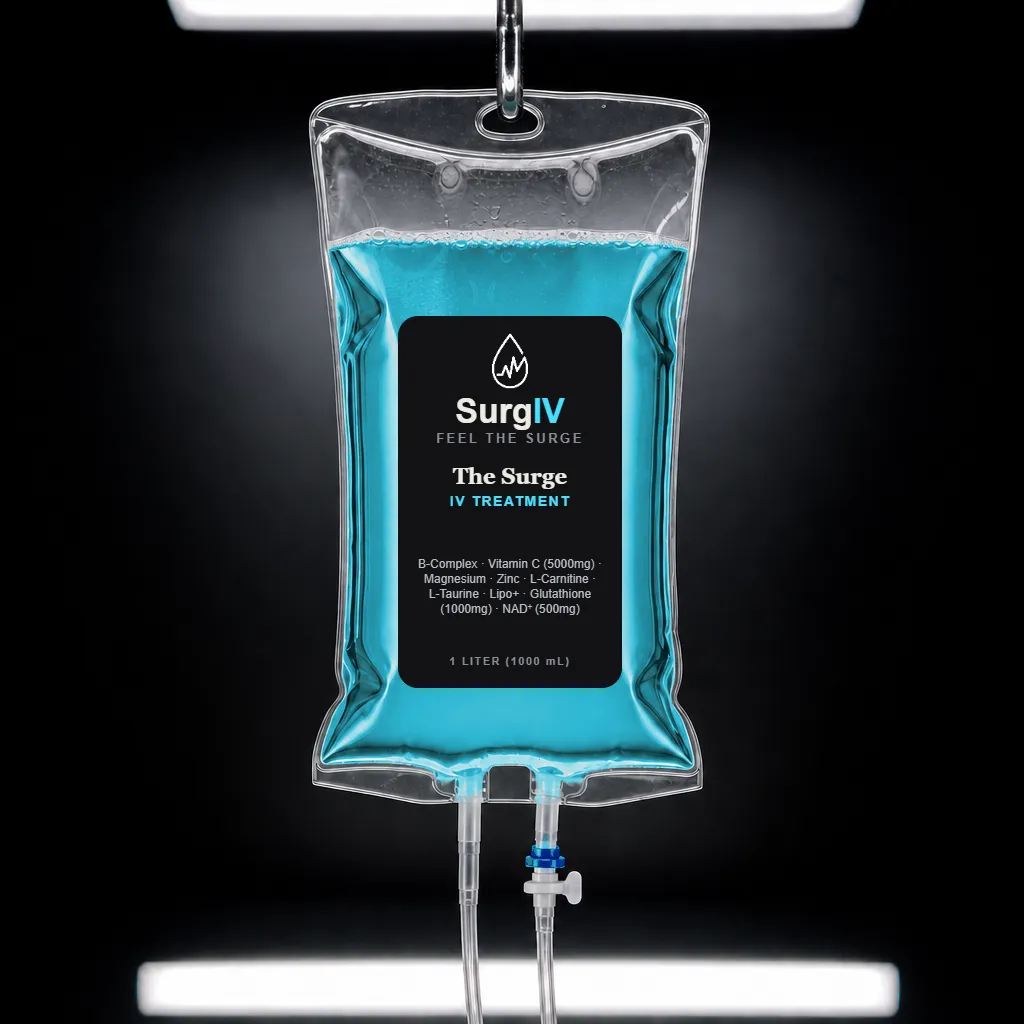
Fund the plant. Don't just silence the alarm.
The Surge $899
500mg NAD⁺ plus the full supporting formula — energy from production, not stimulation.
IV Bag: B-Complex · Vitamin C (5000mg) · Zinc · Magnesium · L-Carnitine · L-Taurine · Lipo+ + more
The grown-up energy stack
This was never actually caffeine versus NAD⁺ — it's about assigning each the right job. Caffeine: a morning tool, used because you enjoy it, cut off by noon. NAD⁺ rhythm: the capacity layer underneath, maintained monthly-ish. Sleep: the non-negotiable foundation both of them should be protecting, not spending. Run that stack for a month and you'll notice the strangest thing — the espresso machine becomes a pleasure again instead of a dependency. The tank's full. The gauge can tell the truth.
This article is for general education and is not medical advice. IV therapy at SurgIV is administered by registered nurses under physician-written protocols, with a health screening before your first visit. Talk to your doctor about what is right for you.