
The email arrives every year, in every office, around mid-October. An HR manager we'll call Sandra — 140-person professional services firm in West Palm — can recite her version from memory: "Team — with several folks under the weather, please remember to stay home if you're sick! 🤒" She sends it, she says, "the way you'd throw a paper cup of water at a house fire. Todd from sales flew back from the Vegas conference with a cough on Monday. It's Thursday. I can hear the third floor from here."
Every workplace runs this script annually. Here's the version of the plan that actually moves the absentee numbers — the one Sandra built after the year Todd's cough took out the Q4 pipeline review.
The math HR already knows but leadership forgets
Germ season's business problem isn't the sick day — it's the cluster. One contagious employee working through days one to three (peak shedding, because your culture applauds toughing it out) typically seeds multiple colleagues, converting one partial-productivity week into a department-wide absence wave two weeks later — timed, with perfect cruelty, against Q4 close. Presenteeism isn't dedication; it's a virus subsidy program with good PR. Which makes the counterintuitive first policy the highest-ROI one: make staying home genuinely costless — leave that doesn't punish, norms modeled by managers (the VP who Zooms in sick from home is worth ten reminder emails), and zero hero points for the conference-room cough.
"I can hear the third floor from here." — Sandra, and every HR manager, every October
The defense calendar
Sandra's plan runs on the school-year rhythm (because that's what drives the community wave — see the September merger):
- Early October — the pre-season. Stay-home norms re-announced with teeth (managers briefed, examples set), sanitizer stations at the chokepoints (elevator banks, shared kitchens, the conference-room table that is functionally the office's classroom), and the programming centerpiece: the team immunity day — on-site Immune Boost sessions run on the standard wellness-day chassis, employees booking hour slots, individually screened. The timing is the point: the armory gets stocked before the wave, not during the casualty count.
- Mid-season — the January second front. The post-holiday return is germ season's second landing (every family gathering was a mixing event); the January booster day meets it, and doubles as a morale beat in the quarter's grimmest month.
- Continuous — the outbreak protocols. When a wave hits anyway: meeting hygiene (that recurring 20-person status call goes remote for two weeks), the comeback guidance circulated so returning staff don't relapse into the second-week drag, and the quiet manager's-discretion flex days that turn "pushing through" into "back at full strength Thursday."
Selling it upstairs
The budget conversation, as Sandra ran it: sick-day clustering is already in HR's spreadsheet, its Q4 timing is already leadership's least favorite fact, and the full program — policies plus two on-site immunity days — costs per employee a fraction of a single absent day. "I didn't pitch wellness," she reports. "I pitched attendance insurance for the close. Finance approved it in one meeting, which in this firm is a land-speed record."
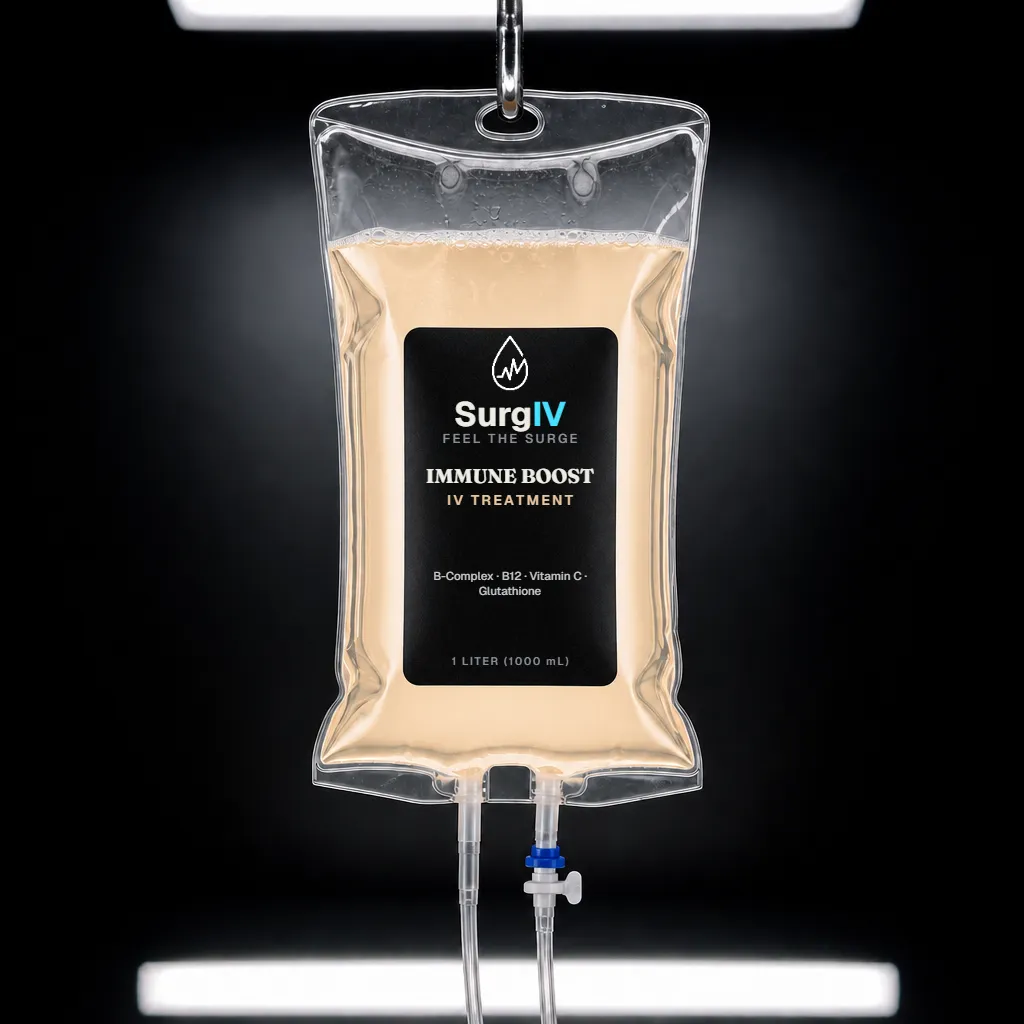
The team immunity day
Immune Boost $299
On-site immune support sessions before the season hits — the wellness perk with an attendance ROI.
B-Complex · B12 · Vitamin C · Glutathione
Sandra's season, year two
The results she presented in March: seasonal sick-day cluster down measurably year over year, zero department-wide waves, the immunity days oversubscribed within a day of announcement — and Todd from sales, patient zero emeritus, first in line at the October session, a conversion Sandra describes as "the program's true ROI." The reminder email still goes out every October. It just has a plan standing behind it now.
This article is for general education and is not medical advice. IV therapy at SurgIV is administered by registered nurses under physician-written protocols, with a health screening before your first visit. Talk to your doctor about what is right for you.