Somewhere in a gas station right now, a man is holding a neon can the size of a fire extinguisher, reading the ingredient list, and drawing the conclusion millions have drawn before him: caffeine, sugar, taurine — so taurine must be the hard stuff. The can's marketing has spent thirty years encouraging exactly this inference, cartoon bull and all.
Here's the funny truth: taurine is not a stimulant. It has never been a stimulant. If anything, its nervous-system lean is calming. The most misunderstood molecule in the beverage aisle is essentially a quiet structural engineer who got cast in an action movie — and its actual résumé is better than the role.
What taurine really is
Taurine is an amino acid — technically an amino sulfonic acid — that your body synthesizes and concentrates in exactly the tissues that work hardest: skeletal muscle, heart, brain, eyes. It's not used to build proteins like other aminos; it's a free agent with jobs of its own:
- Muscle calcium handling. Contraction and release run on calcium flows, and taurine helps regulate them — supporting clean contractions and, notably for the cramp-prone, clean releases. This is why athletes and formulators care.
- Cellular hydration management. Taurine is an osmolyte — cells use it to regulate their own fluid balance under stress. In a recovery context (sweat losses, fluid shifts), that's a direct supporting role in the hydration story.
- Heart muscle support. Cardiac tissue maintains some of the body's highest taurine concentrations — the molecule participates in the heart's contractile machinery, and research interest there is long-standing and serious.
- The supporting cast roles: bile formation (fat digestion), membrane stability, antioxidant-adjacent duties. Structural, unglamorous, everywhere.
The can promised you wings. The molecule was quietly maintaining your calcium channels the whole time.
Why it ended up next to the cartoon bull
The energy-drink industry needed ingredients with metabolic credibility, and taurine — genuinely involved in muscle and energy physiology, safe at generous doses, cheap to add — fit the label. The drinks' felt effect is overwhelmingly the caffeine and sugar; taurine rides along absorbing credit and blame it never earned. The collateral damage is reputational: a legitimately useful recovery amino now reads as gas-station chemistry to half the public. Molecules, like people, are known by the company they keep.
The better company it keeps here
In our formulas, taurine appears where its actual résumé applies: The Surge and Peak Performance pair it with L-carnitine (muscle energy metabolism), magnesium (its partner in the contraction-release chemistry), full hydration (the osmolyte's working medium) and glutathione — delivered intravenously at doses that skip the absorption toll booth. No sugar, no cartoon livestock, no wings promised: just the quiet structural engineer, finally on the right project.
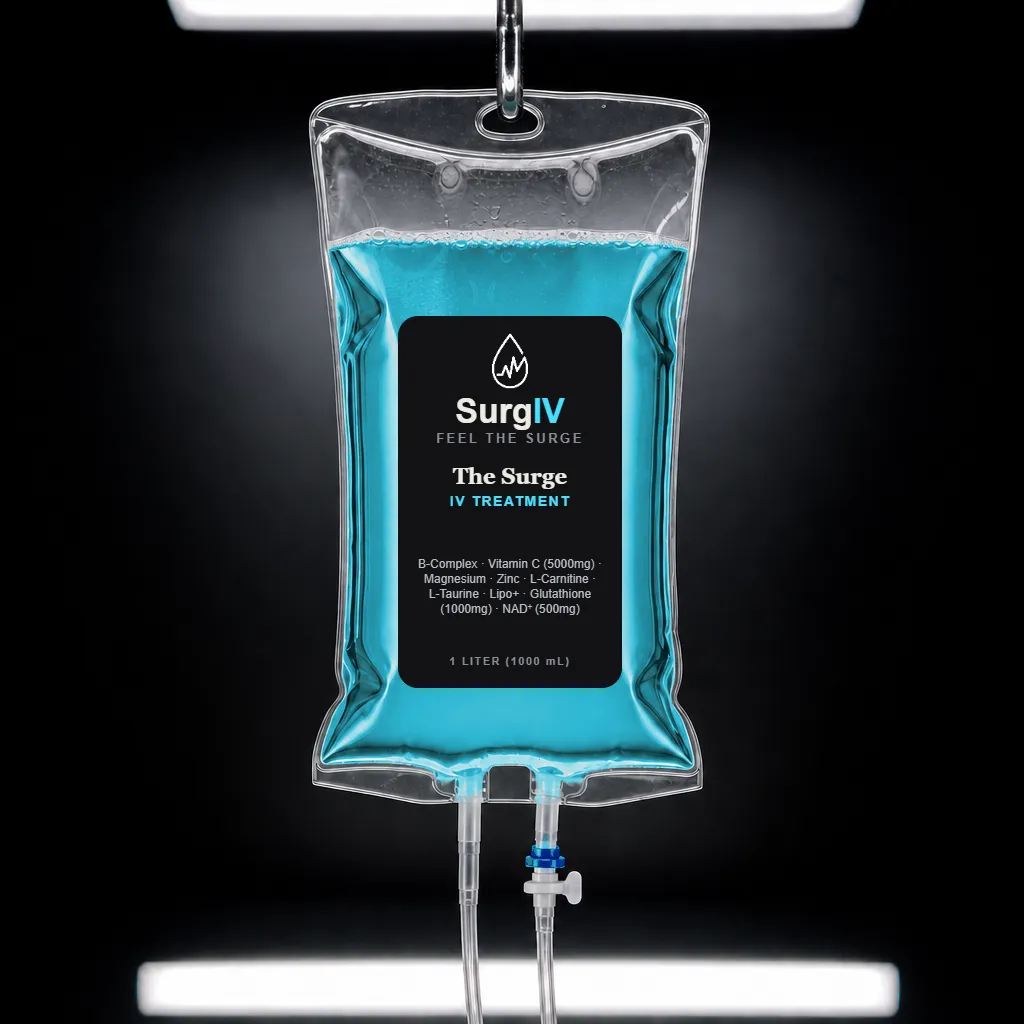
Taurine, in real company
The Surge $899
Alongside carnitine, glutathione and NAD⁺ — the formula the molecule always deserved.
IV Bag: B-Complex · Vitamin C (5000mg) · Zinc · Magnesium · L-Carnitine · L-Taurine · Lipo+ + more
The gas-station verdict
Next time you see the neon can: the taurine inside is innocent, the caffeine is doing the shouting, and the sugar is writing checks your 3 PM will cash. If you want what taurine actually offers — muscle function, cellular hydration, recovery support — it was never in the can in meaningful context anyway. It was in the formula bag all along, sitting next to better friends.
This article is for general education and is not medical advice. IV therapy at SurgIV is administered by registered nurses under physician-written protocols, with a health screening before your first visit. Talk to your doctor about what is right for you.