Saturday, 11:20 AM, a league match at a club in Boca. Third set, 2-2. Our client — call her Priya, 47, captain of her 4.0 team — is standing at the baseline watching her own toss wobble. First set, she was surgical. Second set, solid. Now her feet are arriving late to balls she read perfectly, her grip is slick, and between points she's doing that thing where you lean on the fence and pretend it's strategy. Across the net, her opponent — younger, but honestly no better — looks fresh. Priya's thought, which she told us later verbatim: "When did I get old? Like, at what specific game did it happen?"
It wasn't age. It was arithmetic. A three-set Florida match is two competitions running simultaneously — the tennis, and the cooling — and whoever loses the second one loses the first.
The second competition
Two hours of competitive singles or doubles in Florida heat costs 2–3 liters of sweat, and tennis compounds the loss cruelly: it's a fine-motor sport. The research on mild dehydration reads like a scouting report on late-set collapse — reaction time slows, decision-making degrades, coordination gets sloppy — all beginning around 2% of body weight down, which for most players arrives early in the second set. The wobbling toss, the late feet, the inexplicable third-set errors: that's not nerves or age. That's a cooling system out of margin, taxing exactly the systems tennis runs on. Priya's opponent wasn't fresher because she was younger. She was fresher because she'd been drinking electrolytes at every changeover while Priya's water bottle sat full — the second competition, forfeited quietly.
Nobody loses the third set to their opponent. They lose it to the first two sets' sweat.
Playing the second match on purpose
- Arrive topped up. Pre-hydration with electrolytes the evening before and morning of — starting a match already 1% down (standard for coffee-breakfast players) means hitting the performance cliff a set early.
- Changeover discipline: several swallows of electrolyte fluid every single changeover, thirsty or not — thirst is a late alarm in heat. Plain water alone on multi-liter losses dilutes remaining sodium; it's the grid, not just the tank.
- Cool the radiators: ice towel or frozen bottle on neck and wrists at changeovers — the pros do it because surface cooling buys real core-temperature margin.
- Respect the schedule: the 8 AM match is a different sport than the noon match. When you control scheduling, control it.
Tournament weekends: the between-matches war
League playoffs and tournament brackets add the layer that decides Sundays: recovery between matches. Saturday's deficit rolls into Sunday's first serve unless it's settled aggressively — and this is where our tennis members run the same protocol as our golfers: Peak Performance 36–48 hours before the bracket, and the Recovery IV Saturday evening — full rehydration plus aminos, at home, so Sunday's third set gets Saturday-morning legs.
Built for match play
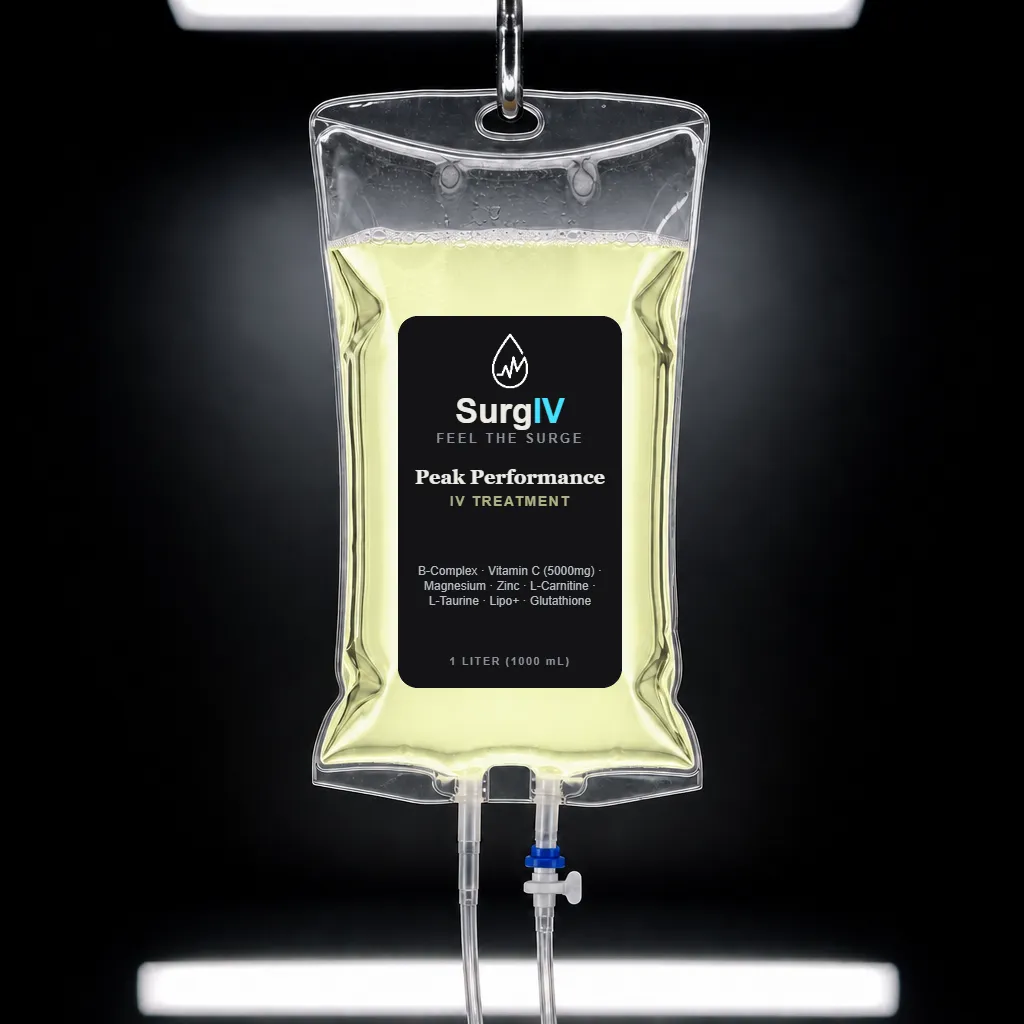
Peak Performance $499
Hydration, aminos, B vitamins and glutathione — the competitor's formula before tournament weekends.
IV Bag: B-Complex · Vitamin C (5000mg) · Zinc · Magnesium · L-Carnitine · L-Taurine · Lipo+ + more
Priya's rematch
Same opponent, six weeks later, districts. Priya ran the full protocol — pre-hydrated, changeover discipline, ice towel her teammates mocked until they didn't — and won the third set 6-2, moving like the first. Her post-match text to our dispatch is now our favorite scouting report: "Turns out I'm not old. I was just the only one playing both matches."
This article is for general education and is not medical advice. IV therapy at SurgIV is administered by registered nurses under physician-written protocols, with a health screening before your first visit. Talk to your doctor about what is right for you.