
6:47 AM, a bedroom in Boynton Beach. The sleep app on the nightstand is displaying what can only be described as a taunt: 8 hours, 12 minutes. Sleep score: 84. And the owner of that score — call her Melissa, 44 — is lying there running the morning's first calculation, which is how many more minutes she can stay horizontal before the day files a missing-person report. Eight hours. Twelve minutes. Score of 84. She feels like she slept four.
"Tired after 8 hours of sleep" is one of the most-searched health phrases in English for a reason: the math feels broken. It isn't — but the answer lives on a checklist, not in a single fix, so here's the systematic walk, ordered from most-common-and-fixable to see-a-doctor. It's roughly the sequence a good clinician would run.
Layer 1: You slept long, not deep
Duration and quality are different products. Eight hours fragmented by alcohol (the great deep-sleep thief — even two evening drinks measurably flatten the restorative stages), late caffeine (a 3 PM cold brew is still ~25% in your blood at 9), a warm bedroom, or 1 AM doomscrolling can deliver a full-length, low-quality night — the sleep equivalent of eight hours in an airplane seat. The tell: you sleep "enough" but never feel the bottom of it. The fixes are the boring famous ones, and the alcohol one is the one everyone skips.
Layer 2: The overnight drain (the underrated one)
You lose roughly a pound of water overnight just breathing and sweating — and if bedtime-you was already carrying Florida's standing deficit, wake-up-you is at the day's hydration minimum. Morning fatigue plus dull headache plus dark first-urine is dehydration's signature, and it masquerades as "bad sleep" constantly. The test costs nothing: front-load fluids with electrolytes in the first hour and see if "exhausted" downgrades to "human" by 8 AM.
The app scores the hours. It can't score what the hours were working with.
Layer 3: The supply closet
Sleep is the repair shift; nutrients are its materials, and a few specific shortfalls produce exactly this morning: B12 (the heavy-legs, foggy-start signature — full signs here; risk rises over 50 and on acid reducers or metformin), vitamin D (the Florida paradox — we live in AC and SPF), magnesium (low levels degrade sleep quality itself, a self-tightening loop), and iron (worth a doctor's test, especially for menstruating women and endurance athletes — not a wellness-drip item). And underneath the specific nutrients, the age-related layer this blog maps relentlessly: the NAD⁺-and-sleep loop, where the repair shift itself runs underfunded.
Layer 4: The medical floor
When layers 1–3 are honestly clean and mornings stay broken past a few weeks, stop optimizing and get examined. The headliners: sleep apnea (loud snoring, witnessed pauses, morning headaches — massively underdiagnosed and very treatable), thyroid (fatigue plus cold intolerance plus weight drift), anemia, and depression, whose morning heaviness is real and deserves real care. A $40 lab panel outperforms a year of guessing — we say this as people who sell the guessing-adjacent product.
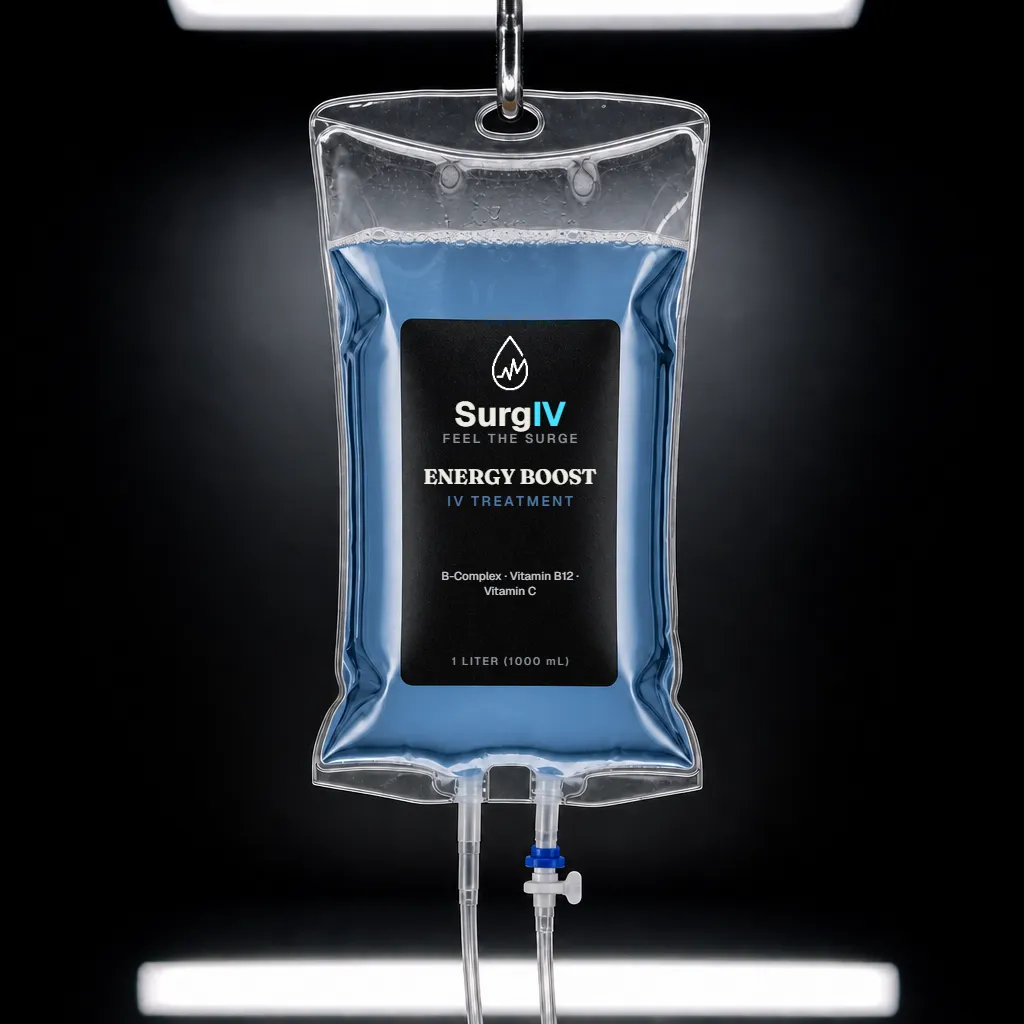
The depletion rule-out
Energy Boost $249
Hydration and B vitamins at full dose — clear the most fixable causes in one session.
B-Complex · Vitamin B12 · Vitamin C
Melissa's layer
Melissa's turned out to be 2-and-3: a chronic fluid deficit plus B12 flattened by the omeprazole she'd taken for years (classic, and nobody had ever mentioned it). One Energy Boost session as the rule-out test, a dramatic Thursday morning, a doctor's confirmation lab, and a monthly rhythm later — her sleep score is the same 84, and her review is the whole checklist in one line: "Turns out I was sleeping fine. I was just waking up into a body with nothing on the shelves."
This article is for general education and is not medical advice. IV therapy at SurgIV is administered by registered nurses under physician-written protocols, with a health screening before your first visit. Talk to your doctor about what is right for you.