
During her first session, a client in Boca — call her Rachel, 41, reads every label in every store — watched our nurse assemble her bag on the kitchen counter and asked the question that immediately identified her as our kind of person: "Okay, walk me through it. What is actually in there? Because I have never once seen an ingredient panel on an IV bag in my life."
Fair. The IV bag might be the only consumable in modern life that most people accept entirely on faith — a clear sack of mystery, hung by an authority figure. So here's the walkthrough Rachel got, in the same order the bag gets built. By the end you'll read any drip menu in the county like a nutrition label — including the ones hoping you can't.
Layer 1: The base fluid (the vehicle)
Every bag starts as a sterile salt-water foundation, and there are two main recipes. Normal saline: water with 0.9% sodium chloride — the exact salt concentration of your blood, which is why it can flow into a vein without cellular drama. Simple, proven, everywhere. Lactated Ringer's: saline's more sophisticated sibling — adds potassium, calcium and a lactate buffer, approximating your blood's fuller electrolyte profile; it's the base our rehydration-forward formulas favor. Volume matters more than people realize when comparing menus: a full liter versus a 500ml half-bag is literally half the rehydration — and half-bags at full prices are the industry's quietest markup.
Layer 2: The electrolyte tuning
On top of the base salts, formulas tune the mineral grid: magnesium (the release mineral — also responsible for the pleasant calm mid-drip), potassium within careful limits, calcium, zinc. This layer is where a rehydration bag becomes a recovery bag — replacing what sweat, illness or alcohol specifically drained rather than just refilling water.
Layer 3: The payload (where formulas differ)
Here's where menus earn their names — the vitamins and actives added per-formula from pharmaceutical single-dose vials at prep time (watch your nurse build it; that assembly is a quality marker, not improvisation):
- The B family — the energy payroll, and the source of the famous yellow tint.
- Vitamin C — at gram doses only this route delivers.
- Amino acids — carnitine, taurine: the muscle-recovery crew.
- Glutathione — usually pushed at the end as its own dose; the cleanup chief.
- Medications where protocols allow — anti-nausea and anti-inflammatory support in recovery formulas, physician-directed.
- NAD⁺ — the premium payload, run slow, with narration.
The bag is a recipe: a vehicle, a mineral tune-up, and a payload. Every menu in the county is just those three layers — with or without the milligrams printed.
How to read any menu now
Armed with the layers, comparison becomes arithmetic: What's the base and is it a full liter? Which minerals, which payload — and crucially, at what milligrams? "Contains glutathione" without a number is decoration (token doses hide behind ingredient lists); real operators publish milligrams because real doses are the product. Add the provider questions — who compounds, who administers — and you've got the complete literacy kit. Our own answer to all of it is the menu itself: every formula's full ingredient list and doses, published, because we'd rather compete on contents than on mystery.
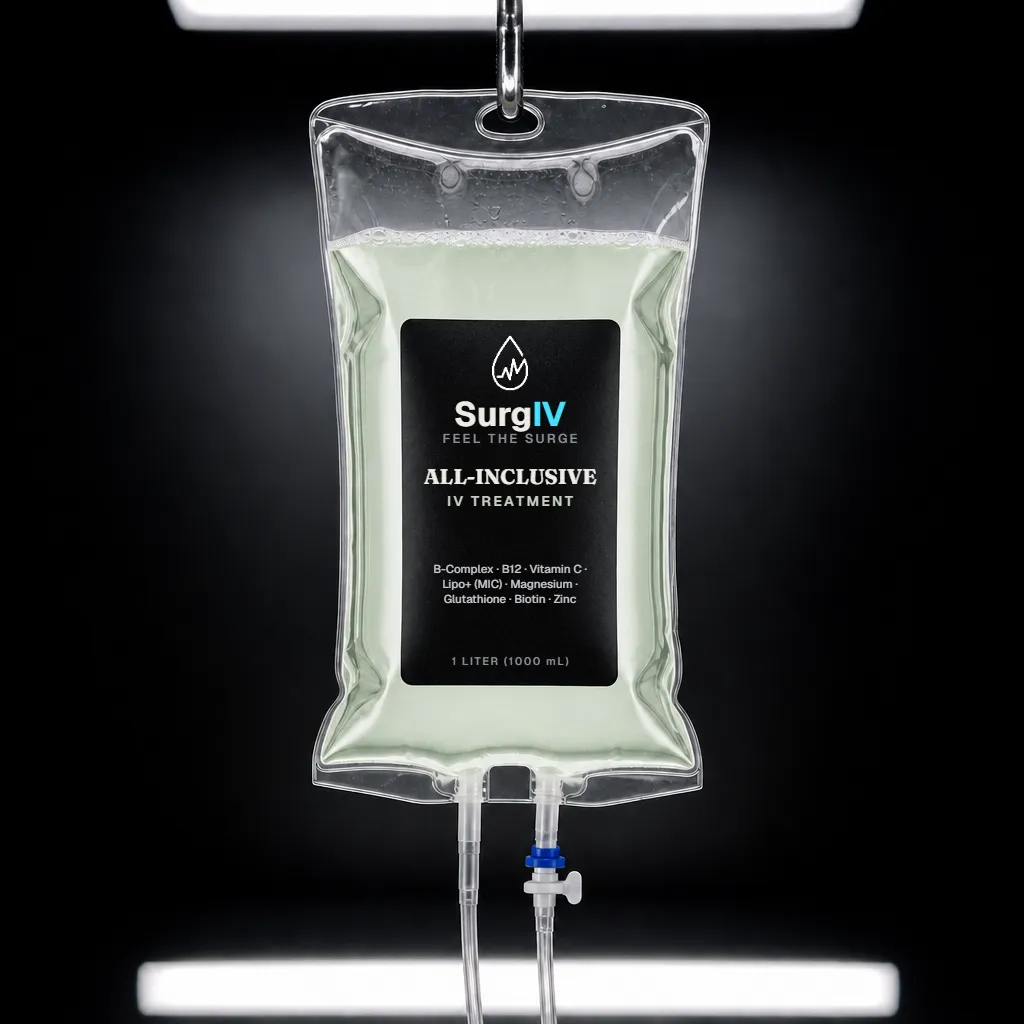
Full transparency, full doses
All-Inclusive $349
Every ingredient and milligram published — read our bags like a label, because they are one.
B-Complex · B12 · Vitamin C · Lipo+ (MIC) · Magnesium · Glutathione · Biotin · Zinc
Rachel's verdict
Rachel read our whole menu during her drip, cross-examined the nurse on two milligram counts (correctly cited), and delivered the closing line we've adopted as a standard: "First IV I've ever had that came with a label. Should've been the industry's idea, not the customer's." Agreed. Now you can hold every bag in the county to it.
This article is for general education and is not medical advice. IV therapy at SurgIV is administered by registered nurses under physician-written protocols, with a health screening before your first visit. Talk to your doctor about what is right for you.