11:40 PM, Wednesday, a conference room at a West Palm firm, trial day three of a projected ten. A litigator we'll call Diane — 47, first chair, the calm one — surveys the war room: three associates annotating deposition transcripts, a dinner of vending machine provenance, a whiteboard that has evolved its own legend, and her own reflection in the dark window looking like opposing counsel's best exhibit. Her paralegal, leaving: "Get some sleep, Diane." Diane, highlighting: "Sleep's for after the verdict." It's a great line. It's also, by week two, precisely how trials get lost.
The cortisol marathon
Trial is the rare white-collar event with genuine physiological extremity: courtroom hours are sustained fight-or-flight — public performance under adversarial pressure is among the most reliable cortisol triggers ever measured, and a litigator runs it six hours a day for weeks. Stack the substrate: five-hour nights, vending dinners, the executive depletion pattern at double speed, caffeine escalating to meet the fade, and a schedule with zero recovery windows by design. The body bankrolls week one on adrenaline. Week two, the loans come due — and they come due in the exact currency trials are won with.
Cross-examination runs on working memory, reaction time, and judgment — the three faculties sleep debt degrades first, and the three whose degradation you can't feel from inside.
The week-two trap
Here's the finding every trial team should have taped to the war-room door: after multiple short nights, cognitive performance drops measurably while self-assessed performance doesn't — the sleep-deprived brain grades itself on a curve. The attorney who traded sleep for one more transcript pass walks into court certain she's sharp and objectively isn't: slower to catch the witness's inconsistency, a beat late on the objection, the all-nighter arithmetic amortized across a fortnight. Diane's "sleep's for after the verdict" is the war story culture talking. The verdict, inconveniently, is being decided by whichever team's prefrontal cortex is better rested.
The litigator's protocol
The floor: six hours minimum, treated as case strategy — the last two prep hours are reliably worth less than the sleep they cost. The courtroom: protein breakfast before appearance, water at counsel table (dry courthouse air plus six speaking hours is a genuine dehydration mechanism — the 3 PM courtroom fog is often fluid, not fatigue), caffeine capped by 2. The war room: a closing time, enforced by the first chair because no one else can. The calendar: the three-slot IV pattern the county's trial bar has quietly adopted — pre-trial (enter week one topped up, not pre-depleted by prep), the mid-trial weekend reset (fluids, B vitamins, the recovery the schedule prohibits, delivered to the home the litigator briefly visits), and post-verdict — because the crash after sustained cortisol is real physiology, and the next case's prep starts sooner than anyone admits.
War-room logistics
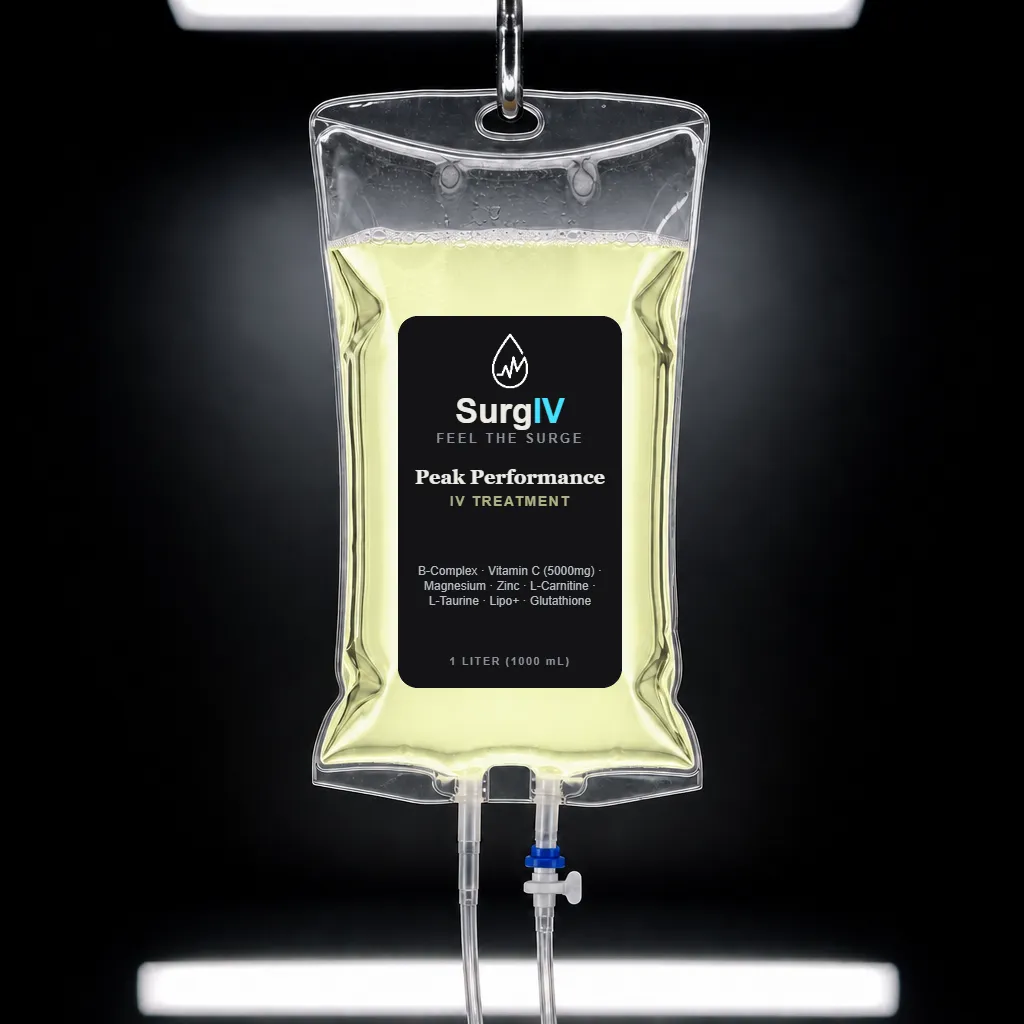
Peak Performance $499
The firm sends dinner to the conference room. Send this too.
IV Bag: B-Complex · Vitamin C (5000mg) · Zinc · Magnesium · L-Carnitine · L-Taurine · Lipo+ + more
Diane, verdict in
She ran the protocol from day four — floor enforced, war room closed at 11, the Sunday reset drip between weeks. Day nine, opposing counsel's key witness contradicted a deposition line; Diane caught it in real time, the beat that broke the case. Post-verdict, to the associates, over a dinner that involved actual plates: "Week two is won in bed and at counsel table's water pitcher. The transcripts don't cross-examine anybody. You do — with whatever brain you brought."
This article is for general education and is not medical advice. IV therapy at SurgIV is administered by registered nurses under physician-written protocols, with a health screening before your first visit. Talk to your doctor about what is right for you.