
6:10 AM, a bathroom in Palm Beach Gardens. A man we'll call Craig — the 14-percent-battery Craig, eighteen months post-renovation and doing well — is on the phone with his younger brother, who turned 40 last week and has called in a state. "Nothing CHANGED," the brother is saying. "Same gym, same job, same everything. And this year it's like someone turned the difficulty up. The knees. The 2 AM wake-ups. The two-day hangovers. WHEN did this happen?" Craig, who asked the same question at the same age in the same tone: "It didn't happen this year. It's been happening for ten. This is just the year the invoice cleared."
The slopes behind the cliff
There is no physiological event at 40 — there are five slopes, and they cross the visibility line together. NAD⁺ decline: the coenzyme underwriting cellular energy and repair has been sliding since the 30s; by the mid-40s the felt version is "same hours, higher cost." Muscle drift: mass declines steadily without deliberate training — the after-40 primer covers the arithmetic. Sleep architecture lightening: deep sleep's share shrinks, the 2 AM wake-ups arrive, and every other system's overnight repair inherits the shortfall. Recovery intervals stretching: the new tax brackets, applied to workouts, illnesses and rough nights alike. Hormonal shifts: gradual for everyone, differently shaped by sex. Each alone: invisible. Their sum: the brother's phone call, made by nearly everyone within eighteen months of the birthday.
The 40s aren't when the body changes fastest — that was the 30s, quietly. The 40s are when the margins run out and the drift finally invoices.
Why it lands exactly now
The cruelty of the timing is supply meeting demand: the decade the biological margins thin is precisely the decade life's demand curve peaks — career apex, young kids or teenagers, aging parents, the calendar with no white space. A 30-year-old runs the same slopes with margin to burn; the 45-year-old runs them at full allocation, so every slope reads as a cliff. Which reframes the whole decade: the problem isn't the drift — it's running a drifting system on a 25-year-old's operating manual, the manual that assumed recovery was automatic, sleep was optional, and margins were infinite.
The adjustable list
The honest good news — more of this is levers than the cliff narrative admits: strength training counters the muscle drift directly (the decade's single highest-leverage input, twice weekly, non-negotiable); sleep architecture responds to deliberate design — the alcohol curfew, the consistent window, the dark room; recovery debt responds to scheduling recovery like the appointment it is; and the NAD⁺ slope is the one with a direct restoration route — loading protocols and precursors, the intervention the county's 40-something conversation keeps arriving at, honestly framed: one slope among five, complementing the stack, replacing nothing. The Surge was built for exactly this decade's ledger — NAD⁺ plus the full panel, the maintenance contract for the years when maintenance stopped being automatic.
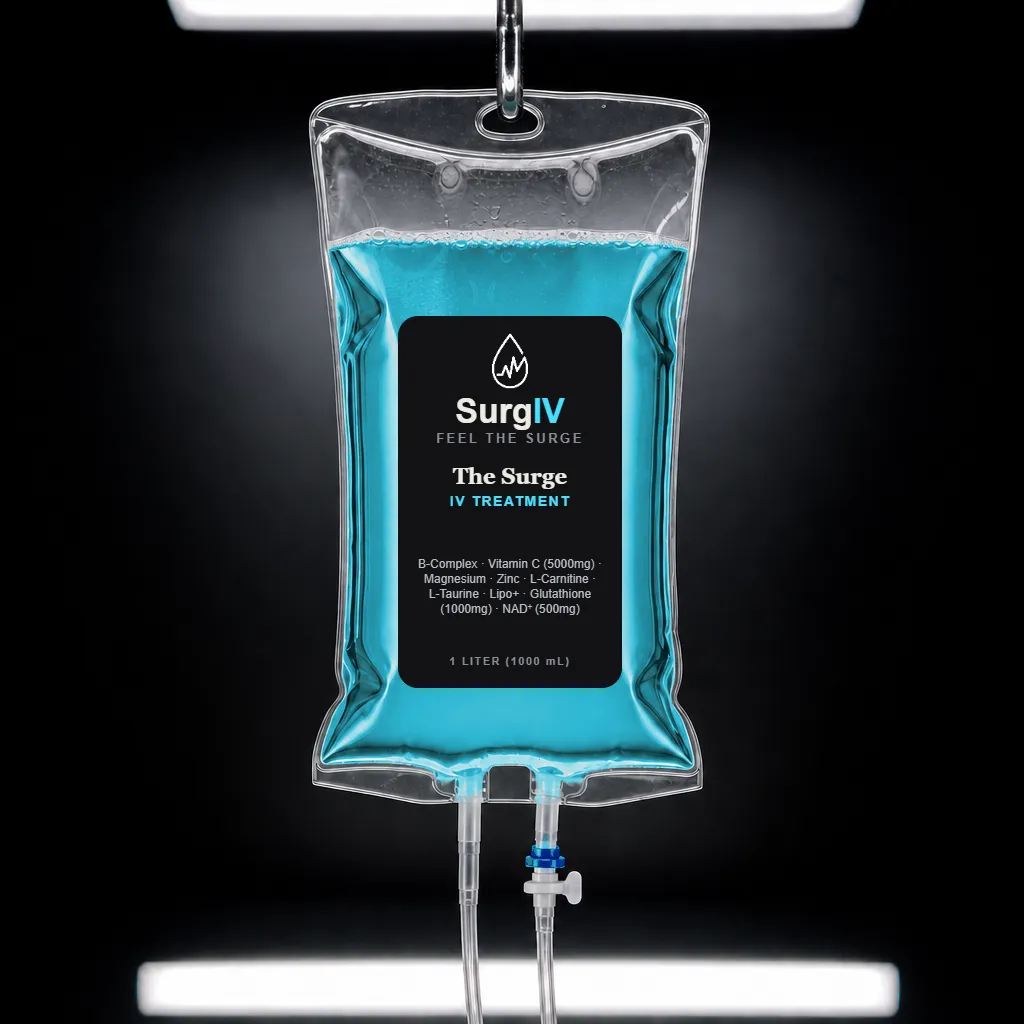
Built for this decade
The Surge $899
NAD⁺ and the full panel — the formula the 40s conversation keeps arriving at.
IV Bag: B-Complex · Vitamin C (5000mg) · Zinc · Magnesium · L-Carnitine · L-Taurine · Lipo+ + more
The brother, one year in
He got the manual update: two lifting days, a sleep window, the drinking recalibrated, quarterly Surge. The one-year report, called in at 6 AM from a morning run: "41 feels better than 39 did. Turns out the cliff was a slope, and slopes have handrails. Nobody TELLS you that — they just let you fall off the year and assume it's over." It isn't. It's just the year the manual needs rewriting — and the rewrite works.
This article is for general education and is not medical advice. IV therapy at SurgIV is administered by registered nurses under physician-written protocols, with a health screening before your first visit. Talk to your doctor about what is right for you.